
Overview
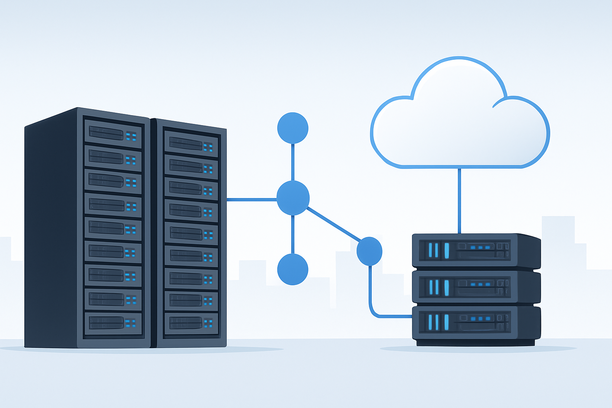
Training a chat AI model and serving it to users are two fundamentally different computational tasks, each demanding a distinct server infrastructure. Training servers are engineered for raw compute power and massive parallel processing to handle long, resource-intensive learning cycles. Inference servers, by contrast, are optimized for low-latency, high-throughput prediction delivery in real-time. Choosing the right server for each phase is critical for performance, cost, and scalability.
Why Training and Inference Server Requirements Diverge
The core difference lies in the workload characteristics. Training is a batch-oriented, compute-heavy process that processes entire datasets to update model weights. Inference is an online, latency-sensitive task that processes individual requests to generate responses.
Training workloads are characterized by:
- Massive parallelism: Thousands of GPU or TPU cores working simultaneously.
- Long job duration: Training runs can last days or weeks, requiring high uptime.
- Large memory footprint: Need for high GPU VRAM to hold large models and batches.
- High-speed interconnects: Crucial for gradient synchronization between nodes.
Inference workloads are characterized by:
- Low-latency response: Users expect sub-second or sub-100ms replies.
- High throughput: Handling many concurrent users and requests.
- Cost efficiency: Paying for capacity that matches real-time demand.
- Scalability: Need to scale up or down with traffic fluctuations.
These divergent needs dictate different hardware, software stacks, and deployment strategies.
Hardware Specifications Compared
The hardware choices for training and inference servers reflect their core tasks. Here’s a breakdown of key specifications.
| Specification | Training Server Focus | Inference Server Focus |
|---|---|---|
| Primary Hardware | High-end GPUs (e.g., NVIDIA A100, H100) in multi-GPU configurations | Inference-optimized GPUs (e.g., NVIDIA T4, L4), high-core-count CPUs, or custom ASICs (e.g., Google TPUs) |
| GPU Memory | Very high (80GB+ VRAM per GPU) to hold large models and batch data | Moderate (16-24GB VRAM may suffice), model-specific |
| CPU | Powerful for data preprocessing | Often high-core-count for parallel request handling |
| RAM | 256GB+ to support data loading and OS | 64-128GB sufficient for most models and context |
| Storage | High-speed NVMe SSDs for dataset I/O and checkpointing | Fast storage for model loading, often less capacity needed |
| Network | InfiniBand or high-speed Ethernet (100Gbps+) for inter-GPU communication | Standard high-bandwidth Ethernet for client connections |
| Form Factor | Multi-GPU servers or clusters | Single or dual-GPU servers, or CPU-only machines |
Training servers often require specialized cluster networks like InfiniBand to minimize communication bottlenecks during distributed training. Inference servers can typically use standard Ethernet but benefit from network configurations that minimize external latency.
Cost and Scaling Models
Cost structures differ significantly between training and inference. Training is a high-upfront, long-term investment, while inference is often an operational expense tied to usage.
Training Costs:
- High initial investment in hardware or reserved cloud instances.
- Long-term commitment for weeks or months.
- Can be optimized with bare-metal servers for predictable, lower long-term costs.
Inference Costs:
- Can scale with demand using cloud auto-scaling or spot instances.
- Pay-per-use models are common.
- Focus on cost per request or cost per 1,000 tokens.
Scaling strategies also differ. Training scales vertically (more powerful single nodes) or across a fixed cluster. Inference scales horizontally by adding more instances to handle concurrent requests.
Deployment and Software Stack
The software environment varies to match the workload. Training requires robust machine learning frameworks (PyTorch, TensorFlow) with distributed training libraries (Horovod, DeepSpeed). Inference requires optimized serving runtimes (TensorRT, ONNX Runtime, Triton Inference Server) for maximum throughput and latency.
Training jobs are often managed by orchestration systems like Kubernetes with specialized operators, while inference services are deployed as microservices behind load balancers and API gateways.
Decision Framework: Which Server Do You Need?
Use this checklist to determine the appropriate server infrastructure for your project phase.
- For Model Training:
- You are building or fine-tuning a chat AI model from scratch or with significant data.
- Your primary need is maximum computational power (FLOPS) for a sustained period.
- You require large GPU clusters with high-speed interconnects.
- Budget allows for significant upfront or reserved instance costs.
- Job runtime is predictable and long (hours to weeks).
- For Model Inference:
- You are deploying a pre-trained model to serve user requests.
- Your primary need is low latency and high throughput for real-time responses.
- You need to scale dynamically with user traffic.
- Budget requires cost efficiency tied to usage.
- You are optimizing for cost per request or token.
Practical Considerations for Chat AI Deployments
When implementing a chat AI system, many teams run both training and inference servers. Here are practical tips:
- Start with cloud for flexibility: Cloud providers offer both training-optimized (like AWS p4d, Google A3) and inference-optimized (like AWS Inf2, Google TPU v5e) instances. This allows experimentation without large capital expenditure.
- Consider bare-metal for sustained training: For long-term, predictable training workloads, bare-metal servers can offer better value and control. Providers like RAKsmart offer customizable GPU server configurations that can be tailored for either training or inference workloads in their Silicon Valley data center.
- Use different regions strategically: Training can often be run in regions with lower electricity costs. Inference servers should be placed geographically close to your user base to minimize latency.
- Monitor and optimize: Use profiling tools to understand your model's performance on target hardware. For inference, optimize model quantization and batching to improve throughput without sacrificing accuracy.
Frequently Asked Questions
Can the same server be used for both training and inference?
Technically, yes, but it is rarely cost-effective or performant. Training hardware is over-provisioned for inference, and inference hardware is often insufficient for training. Using separate, optimized infrastructure is recommended for production systems.
What is the minimum GPU memory needed for chat AI inference?
For most modern chat models (7B-13B parameters), 16-24GB of VRAM is sufficient. For larger models or when using high batch sizes, more memory may be required. Always check the specific model's requirements.
How does latency impact chat AI user experience?
Directly. Users expect responses within 500ms-1 second. Latency above 2 seconds significantly degrades perceived quality and interactivity. Inference servers must be optimized for end-to-end latency.
When should I consider using CPUs for inference?
CPUs are viable for smaller models or when throughput requirements are moderate. They offer lower cost and can be scaled easily. For high-demand, large models, GPUs remain necessary.
How do I estimate the cost for an inference server?
Estimate based on expected requests per second, average tokens per response, and the hardware required to meet your latency targets. Cloud pricing calculators are essential tools for this projection.
Conclusion
The choice between training and inference servers is not a matter of one being better than the other, but of matching the infrastructure to the specific phase of your AI lifecycle. Training demands brute-force computation and long-term resource commitment, while inference requires precision, speed, and operational efficiency. By understanding these distinct requirements, you can allocate resources effectively, optimize performance, and control costs as you develop and deploy chat AI systems.
If you are evaluating infrastructure for either training or inference, exploring a range of hosting solutions—from scalable cloud instances to dedicated bare-metal servers—can help you find the optimal balance for your workload.