
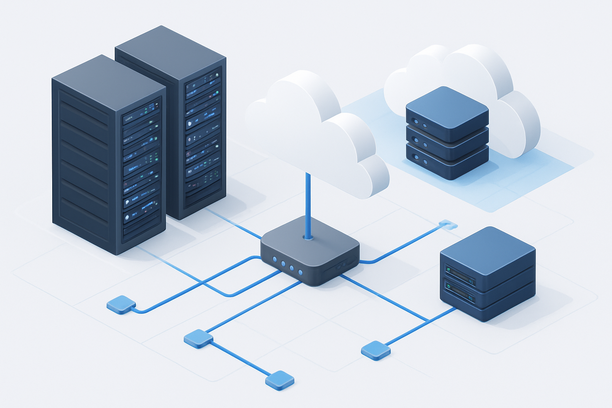
Selecting an AI hosting server is frequently over-simplified to a search for the most powerful GPU, but this focus ignores two factors that determine real-world performance and financial viability: network architecture and total cost of ownership. For AI inference workloads—where models serve predictions to end-users or applications—the path data travels and the billing model are as critical as the compute hardware. This guide moves past specifications to examine the network and cost levers that will make or break your AI service's user experience and budget.
Overview
The optimal AI hosting server for inference is defined by a balance between three pillars: compute power (GPU), network performance (latency and bandwidth), and cost efficiency (billing model). Prioritizing GPU VRAM without considering the network path to your users will result in high latency, while ignoring the cost structure of cloud versus dedicated hosting can lead to unsustainable expenses as your traffic scales. The right choice matches your server's physical location, network capabilities, and payment model to your application's specific geographic user base and traffic predictability.
Why Are Network and Cost Often the Deciding Factors for AI Servers?
For interactive AI applications like chatbots, real-time recommendation engines, or live content generators, the user's experience is directly tied to network latency. A server with top-tier GPUs located far from your user base will deliver slow, frustrating responses. Simultaneously, the cost structure of AI compute is highly variable. A pay-per-minute cloud GPU might be affordable for development but become prohibitively expensive for a service running 24/7. Understanding these dynamics is essential before selecting hardware.
A provider's data center location directly impacts this equation. For instance, a data center situated in Silicon Valley offers a strategic network advantage for applications with a user base concentrated in North America or requiring strong connectivity to Asia-Pacific regions.
How Does Data Center Location Impact AI Server Performance?
Physical proximity minimizes network round-trip time (RTT), which is the single biggest factor in perceived responsiveness for end-user AI applications. When a user sends a request to your AI model and waits for a response, the total time is dominated by data travel time over the internet, not just inference computation.
- For Interactive Applications: An AI chatbot serving users in New York will feel significantly faster if hosted in a US East Coast data center versus one on the West Coast. The reduced latency (often 20-50ms) makes the interaction feel natural and instant.
- For API Services: If your AI model is called by other applications (e.g., a backend service for a mobile app), consistent low latency ensures your entire application stack remains responsive.
- For Global Services: Serving a global user base requires a multi-location strategy or a central location with excellent peering and backbone connectivity to major global internet exchange points.
Therefore, your first technical decision is often geographical. Map your primary user base and choose a data center region that minimizes the average RTT to that audience.
How Do I Model the True Cost of an AI Server?
The true cost of an AI server extends far beyond the monthly fee. A comprehensive Cost of Ownership (TCO) analysis must account for all predictable and variable expenses.
| Cost Factor | Cloud GPU (Pay-As-You-Go) | Dedicated / Bare-Metal Server | Key Consideration |
|---|---|---|---|
| Compute Cost | Per-minute/hourly fee for GPU time. | Fixed monthly fee for exclusive hardware access. | Cloud is flexible but expensive for sustained use. Dedicated is cost-effective for predictable, 24/7 workloads. |
| Storage Cost | High-speed NVMe SSDs billed per GB-month. | Typically included in the base server cost. | Check for egress fees when data leaves the provider's network. |
| Network/Egress Cost | Often a significant variable cost per GB transferred out. | Usually included in a bundled bandwidth package. | High-traffic AI APIs can incur massive egress bills on cloud platforms. |
| Management Overhead | Minimal; provider manages hardware and virtualization. | Higher; requires your team for OS management, security, updates. | Factor in staff time or managed service fees. |
| Scalability Cost | Scales linearly with demand; easy to add/remove instances. | Scaling requires purchasing new hardware or migrating workloads. | Consider future growth projections. |
A dedicated server model, often found with providers in Silicon Valley, can offer a more predictable TCO for stable AI inference services by bundling hardware, bandwidth, and power into a single monthly fee, eliminating surprise egress charges.
What Network Specifications Should I Prioritize for AI Inference?
Once location is determined, focus on these network attributes:
- Low-Latency Uplink: Ensure the server has a direct, low-latency connection to major internet peering points. A 1Gbps port with a congested uplink is worse than a 10Gbps port on a premium network.
- High Bandwidth Allowance: For AI models serving large payloads (e.g., image or video generation), the amount of data transferred per request is high. A plan with ample, or even unmetered, bandwidth is crucial.
- Network Quality for Specific Regions: If your user base is in Asia, a Silicon Valley data center often provides superior, low-latency routes via transpacific submarine cables compared to European or East Coast locations.
Providers may offer features to monitor this performance. For example, access to traffic statistics and bandwidth usage graphs is a basic but essential feature for tracking your AI service's actual data transfer needs and optimizing your plan.
Scenario-Based Comparison: Matching Server to AI Workload
The right network and cost trade-off varies dramatically by use case. The table below helps align your choice with your project's stage and goals.
| AI Server Scenario | Primary Network Need | Primary Cost Priority | Recommended Hosting Model | Example Use Case |
|---|---|---|---|---|
| Development & Prototyping | Standard 1Gbps connectivity. | Lowest upfront cost; flexibility. | Cloud GPU (short-term) or low-tier dedicated server. | A researcher testing a fine-tuned model with a small team. |
| Customer-Facing Interactive App | Ultra-low latency to target users. | Predictable TCO; high performance per dollar. | Dedicated server in a data center near the user base. | A real-time AI character chat service for a North American audience. |
| Backend API for High-Traffic App | High throughput; low latency; consistent uptime. | Predictable bandwidth costs; scalable. | Dedicated server with high-bandwidth plan, or auto-scaling cloud group. | An image analysis API serving millions of requests daily for a mobile app. |
| Internal Research & Batch Processing | High internal bandwidth (for dataset access). | Lowest possible cost for raw compute. | Bare-metal server or high-usage cloud commitment. | Running nightly batch predictions on a large internal dataset. |
Decision Framework: Evaluating an AI Server Provider
Use this checklist to systematically evaluate a hosting provider for your AI inference server.
Step 1: Assess Your Network Requirements
- Where are 80% of your current/future users located geographically?
- What is your maximum acceptable response time (latency) for an AI inference call?
- Do you have predictable or bursty traffic patterns?
Step 2: Model Your Total Cost of Ownership (TCO)
- What is your projected monthly data egress (in GB/TB)?
- Are you comfortable with variable monthly bills (cloud) or do you require a fixed cost (dedicated)?
- What is your team's capacity for server administration (updates, security, monitoring)?
Step 3: Verify Provider Capabilities
- Does the provider have a data center in your priority region?
- Do they offer the specific GPU model and VRAM required for your AI model?
- Can you easily scale hardware (e.g., add RAM, upgrade bandwidth) as your project grows?
- Is traffic monitoring and reporting available to help you manage costs?
When you evaluate providers, look for those that offer a clear path to scale configuration through their management portals and provide transparent data on server performance and network usage.
FAQ
Can I host an AI model on a standard cloud VPS without a GPU?
For serious inference workloads, no. A CPU-only VPS will be orders of magnitude slower for matrix operations central to neural networks. This might be acceptable for trivial, non-latency-sensitive tasks but is not viable for production AI services where speed and throughput are critical.
How much bandwidth does an AI inference server typically use?
This varies enormously. A simple text-based chatbot might use only megabytes per hour. An AI service generating high-resolution images or videos for each request could consume terabytes per month. You must estimate based on your model's output size and expected request volume.
Is a dedicated server always better than cloud for AI?
Not always. Cloud GPU instances are superior for workloads that are highly variable, short-term, or require rapid, elastic scaling. A dedicated server is more cost-effective for stable, predictable, 24/7 inference workloads where you can fully utilize the hardware.
What's the most overlooked factor when choosing an AI server?
Often, it's the total cost of data transfer (egress). AI models can generate large responses, and cloud providers charge significantly for data leaving their network. A seemingly cheap hourly GPU rate can result in a very expensive bill if your application serves many users.
How can I test network latency to a data center before committing?
You can use standard network diagnostic tools like ping and traceroute from your local machine or a server near your user base to the provider's test IP addresses. Many providers also publish network performance benchmarks or offer trial periods.
Conclusion
Choosing an AI hosting server requires looking past the GPU spec sheet to the practical realities of network performance and long-term cost. An AI inference server's value is defined by its ability to deliver fast, consistent responses to its users within a sustainable budget. Start by mapping your users to the optimal data center location, then model the total cost including bandwidth and management. For applications requiring a blend of low-latency performance and predictable costs, exploring dedicated server options in strategic hubs like Silicon Valley can provide the stable foundation your AI service needs to scale effectively.
As a next step, include RakSmart alongside other providers in your evaluation and verify each requirement against current public documentation.