Overview
Deploying an AI chat application on a cloud server involves a structured workflow that transforms a provisioned server into a secure, performant, and observable production service. This guide moves beyond pre-deployment planning to provide a step-by-step workflow, covering environment hardening, dependency installation, containerized model deployment, API configuration, and final production readiness checks, ensuring your service is robust from the first SSH command to the last health check.
Why Is a Sequential Workflow Critical for Deployment Success?
A chaotic deployment process invites configuration drift, security gaps, and difficult-to-debug failures. A sequential workflow ensures each layer—from the operating system to the application API—is stable before the next is built upon it. Skipping foundational steps, like failing to secure recovery access or misconfiguring firewalls, can lead to costly lockouts or exposed services that become vulnerable the moment they receive traffic.
Phase 1: Secure Foundation and Recovery Access
The absolute first steps after provisioning must establish secure access and a recovery plan. This phase prevents permanent lockouts during subsequent hardening.
- Verify Recovery Access: Immediately test out-of-band access methods. For a Bare Metal Cloud server, log in to the control panel and confirm you can reach the VNC Console. This provides hardware-level access independent of network services. As noted in the VNC Console User Guide, this is your lifeline if SSH or RDP becomes inaccessible.
- Establish Secure Primary Access: SSH into your server (Linux) or use Remote Desktop (Windows). Change the default root/administrator password immediately. For Linux, set up key-based SSH authentication for a more secure login method. Document this process and, if needed, refer to password management guides like the Bare Metal Cloud Password Change and Reset Guide.
- Update and Harden the Base OS: Run your system's package manager to apply all security updates (
apt update && apt upgrade -yon Debian/Ubuntu,yum update -yon CentOS). This closes known vulnerabilities before you install any new services.
Phase 2: Environment and Dependency Installation
With a secure base, install the core runtime environments and drivers required for your AI stack.
- Install NVIDIA Drivers and Toolkit: For GPU-accelerated inference, this is non-negotiable. On a clean Linux OS, install the NVIDIA driver from your cloud provider's recommended repository or the official NVIDIA site. Then, install the NVIDIA Container Toolkit to enable Docker GPU access. Always verify with
nvidia-smiafter installation to confirm the driver is loaded and the GPU is visible. - Install Container Runtime: Docker is the standard for deploying AI models due to its reproducibility. Install Docker Engine and Docker Compose. Configure it to run at startup and ensure the current user can run Docker commands without
sudo(add user to thedockergroup). - Configure the Firewall: Now, lock down the server. Using a tool like UFW (Uncomplicated Firewall) on Linux, allow only essential ports:
22(SSH) or3389(RDP) for administration, and80/443for web traffic. Block all other incoming connections. Test your SSH/RDP connection again before you close your current session.
Phase 3: Model Deployment and Service Orchestration
This is the core phase where you containerize and launch your AI inference engine and associated services.
- Choose Your Deployment Method: The table below compares common approaches for deploying the inference server itself.
| Deployment Method | Pros | Cons | Best For |
|---|---|---|---|
| Docker Compose | Simple, single-file orchestration for multiple services (model API, database, frontend). Easy to version and replicate. | Scaling beyond one host requires external tools. | Most production setups; single-server deployments. |
| Docker Swarm | Native clustering in Docker. Easy to scale services across multiple servers. | Less feature-rich than Kubernetes. Smaller ecosystem. | Small-to-medium scale deployments needing simple multi-host scaling. |
| Kubernetes (K8s) | Industry standard for large-scale, resilient deployments. Excellent for auto-scaling, rolling updates, and self-healing. | Significant operational complexity and learning curve. | Large-scale, mission-critical applications requiring high availability. |
| Direct Run (systemd) | No container overhead. Direct control over process management. | Environment dependency hell. Hard to reproduce and migrate. | Legacy systems or environments where containers are not permitted. |
For most new deployments, Docker Compose offers the best balance of simplicity and production capability.
- Define Your Services in
docker-compose.yml: Create a compose file that defines your AI model server (e.g., a container runningvllmorllama.cppwith your model), a reverse proxy like Nginx to handle SSL termination, and any necessary databases. Use health checks and restart policies (restart: unless-stopped) to ensure service resilience.
Phase 4: API Configuration and Load Testing
With services running, configure access and validate performance under load.
- Configure the Reverse Proxy: Set up Nginx or Caddy to act as a front door. It should handle SSL/TLS encryption (using Let's Encrypt for auto-renewal), route traffic to your inference container, and serve static assets for your chat interface.
- Test the API Endpoint: Use tools like
curlor Postman to send test chat completions to your API endpoint. Verify the response format and measure initial latency. Check application logs for errors. - Conduct Basic Load Testing: Use a tool like
locustorwrkto simulate concurrent users. Monitor server metrics during the test (GPU/CPU/RAM usage, network I/O) to identify bottlenecks. This initial test validates your basic capacity and stability.
Phase 5: Production Observability and Final Hardening
Before declaring the deployment live, implement monitoring and perform final security sweeps.
- Set Up Monitoring: Deploy a simple monitoring stack. A common choice is Prometheus for metrics collection and Grafana for visualization. Monitor critical metrics: GPU utilization and temperature, API response latency, container status, and system resources.
- Review and Harden: Perform a final security review. Ensure all secrets (API keys, database passwords) are stored in environment files or a secrets manager, not hardcoded. Verify firewall rules are restrictive. Confirm log rotation is configured to prevent disk fill.
- Document the Deployment: Create a simple runbook documenting your
docker-compose.ymlstructure, key configuration files, and the procedure for updating the AI model or application code. This is invaluable for future maintenance.
Deployment Workflow Checklist
Use this sequence to ensure a methodical deployment:
- Recovery Access Verified
- VNC/Console access tested and confirmed functional.
- Password reset process documented.
- Secure OS Base
- Default password changed.
- System security updates applied.
- Primary user with SSH keys or secure password configured.
- Firewall Configured
- Only admin and web ports (22/3389, 80/443) are allowed inbound.
- Connection to admin port tested from a new session.
- AI Stack Installed
- NVIDIA driver installed and verified with
nvidia-smi. - NVIDIA Container Toolkit and Docker installed.
- User added to Docker group.
- Services Orchestration Defined
docker-compose.ymlcreated with model server, reverse proxy, and health checks.- Services started and running (
docker-compose ps). - API Validated
- Test chat request returns expected response.
- SSL certificate is active and auto-renews.
- Observability & Finalization
- Basic monitoring (e.g., Prometheus) is collecting metrics.
- Application logs are being written and rotated.
- Deployment is documented in a runbook.
Frequently Asked Questions
What OS is best for deploying an AI chat app?
Linux, particularly distributions like Ubuntu 22.04 LTS or CentOS Stream 9, is the industry standard. It offers native support for NVIDIA drivers, superior container performance, a vast ecosystem of open-source AI tools, and is what most official model images and tutorials are built for. Windows Server can be used but often requires more manual setup for GPU drivers and container environments.
How do I choose between a cloud GPU instance and bare metal?
For most deployments, start with a cloud GPU instance. It provides flexibility to scale up or down, pay for what you use, and is faster to provision. Bare metal becomes the better choice when you have very high, sustained utilization (where the cost per GPU-hour is lower), need specific hardware configurations not available in the cloud, or have strict data sovereignty requirements that prohibit virtualization.
Can I deploy on a CPU-only server?
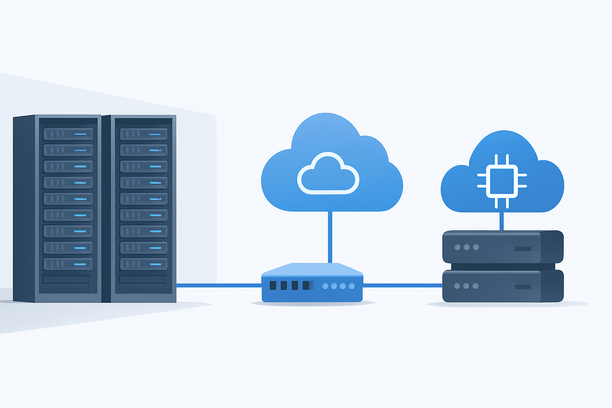
You can run the application layer (web server, API orchestration, database) on a CPU server, but you should not run the large language model (LLM) inference directly on it. CPU inference for models above a few billion parameters is too slow for a real-time chat experience. A common architecture is a cheaper CPU instance for the frontend/API and a separate GPU instance dedicated to running the AI model.
How do I manage secrets like API keys in production?
Never hardcode secrets in your docker-compose.yml or application code. Use .env files with strict file permissions (chmod 600) to pass them into your containers as environment variables. For higher security, use a dedicated secrets manager like Docker Swarm secrets, Kubernetes Secrets, or a cloud provider's secret management service.
What is the first thing to check if my API is responding slowly?
Immediately check GPU utilization with nvidia-smi. If the GPU is at 100%, the model is compute-bound, and you may need a more powerful GPU or to optimize your model (e.g., using quantization). If the GPU is underutilized but CPU or memory is maxed, the bottleneck might be in data preprocessing or network I/O. Use your monitoring stack to identify which resource is saturated.
Conclusion
Deploying an AI chat app successfully requires moving methodically through a structured workflow: securing the server, installing the correct GPU environment, orchestrating services with containers, and validating performance before going live. By treating deployment as a multi-phase engineering process rather than a single command, you build a foundation that is secure, observable, and prepared for growth.
For a reliable infrastructure foundation, consider starting with a cloud or bare metal GPU server from a provider like RAKsmart, which offers the raw performance needed for low-latency inference. Explore their available GPU server plans to match your project's scale.