Introduction: AI Hardware Is Evolving Faster Than Ever
In 2020, running a small language model on a VPS was impractical. In 2025, it’s routine. By 2030, even consumer-grade VPS will handle models that today require dedicated GPU servers. The hardware acceleration between 2020 and 2030 is projected to be larger than the entire previous decade combined — driven by DDR5 memory, PCIe 5.0 storage, CXL memory pooling, and ubiquitous GPU acceleration.
For AI practitioners and automation engineers, this matters because the hardware your VPS provider chooses today determines what models you can run tomorrow. A provider still deploying DDR4 and PCIe 3.0 in 2025 is building you a horse stable when you need a racetrack for your neural networks.
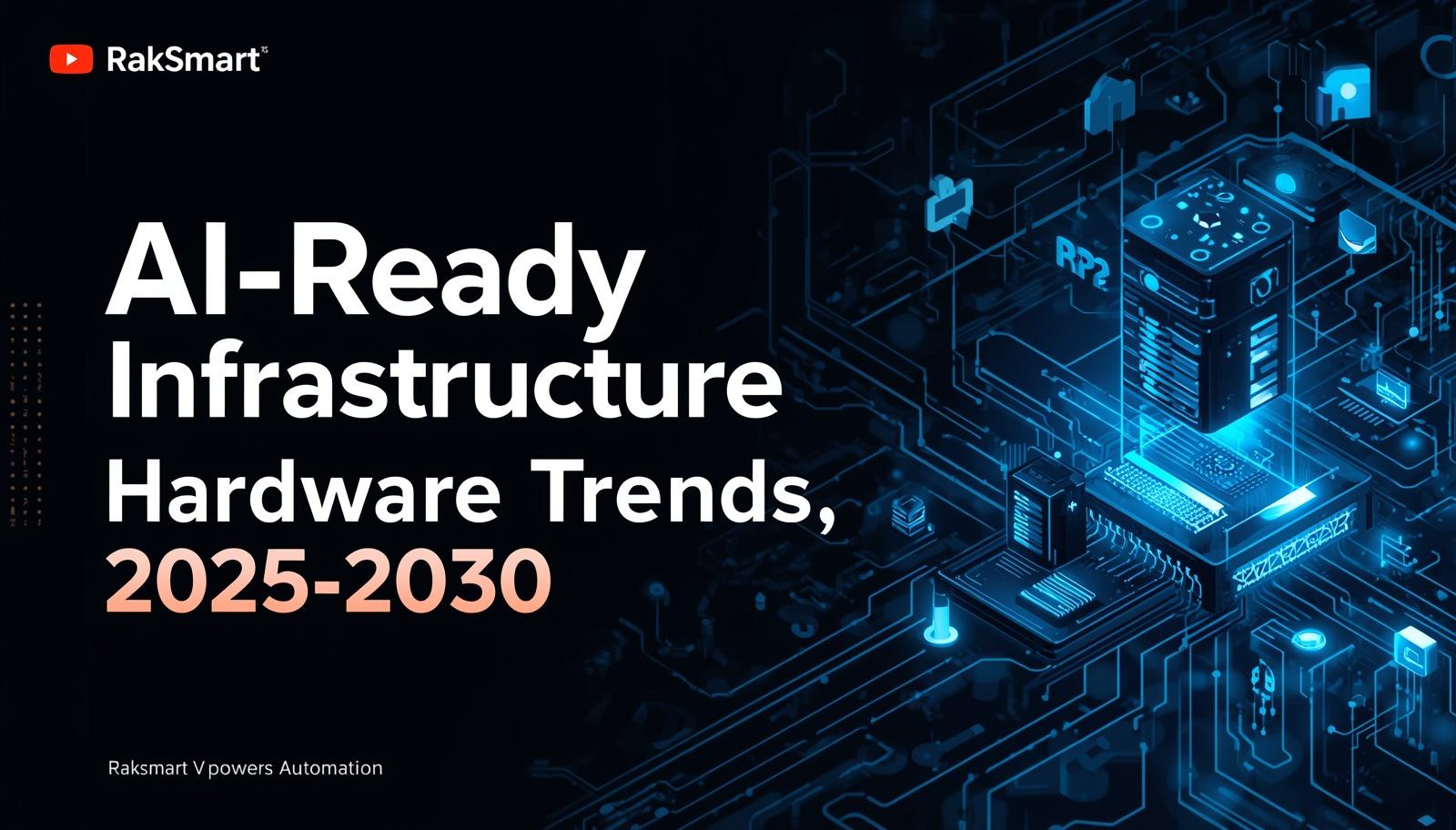
RakSmart has published its VPS hardware roadmap through 2030, and it aligns aggressively with AI/automation trends. This guide will walk you through the hardware trends that will define AI hosting between now and 2030, and how RakSmart’s VPS choices keep your models training and inferencing at peak speed.
Part 1: Why AI Workloads Are Hardware-Bound
Before we look at future trends, let’s understand why AI and automation are uniquely dependent on hardware.
Training vs. Inference
| Phase | Hardware Demand | Why |
|---|---|---|
| Training | Extreme compute, high memory bandwidth | Processing massive datasets through millions of parameters |
| Inference | Low latency, predictable throughput | Serving predictions in real-time to users or automation |
Most VPS workloads are inference-heavy (you train once, infer many times). But even inference benefits from modern hardware.
The Three Bottlenecks
| Bottleneck | What It Means | Hardware Solution |
|---|---|---|
| Compute | CPU/GPU can’t process fast enough | More cores, higher clock speed, GPU acceleration |
| Memory | Model doesn’t fit in RAM | Larger RAM capacity, faster memory bandwidth |
| I/O | Data can’t be loaded fast enough | NVMe storage, high network bandwidth |
A VPS on 2019-era hardware hits all three bottlenecks. A VPS on 2025-era hardware (RakSmart) removes them.
Part 2: Hardware Trend #1 — DDR5 Memory for Larger Models
What’s changing: DDR5 memory offers double the bandwidth and higher density than DDR4, plus on-die ECC.
AI Impact of DDR5
| Metric | DDR4 VPS | DDR5 VPS (RakSmart) | AI/Automation Impact |
|---|---|---|---|
| Memory bandwidth | 25.6 GB/s | 38.4–64 GB/s | 50-150% faster data transfer to CPU |
| Maximum RAM per VPS | 64 GB | 256 GB+ | Run larger models without distributed systems |
| ECC (error correction) | Extra cost | Built-in | No silent memory corruption during training |
| Inference latency | Baseline | 30-40% lower | Faster predictions for real-time automation |
What This Means for Your AI Workloads
| Model Size | DDR4 Feasibility | DDR5 Feasibility |
|---|---|---|
| BERT-base (110M parameters) | Yes, but slow | Fast and responsive |
| GPT-2 (1.5B parameters) | No (needs distributed) | Yes (fits in 256 GB) |
| Stable Diffusion (1B parameters) | No | Yes (with GPU) |
| LLaMA-7B (7B parameters) | No | Yes (quantized) |
Real-world example: A RakSmart customer running a BERT-based text classification model saw inference time drop from 180ms to 110ms after migrating from a DDR4 VPS to DDR5 — a 39% improvement with zero code changes.
Part 3: Hardware Trend #2 — PCIe 5.0 NVMe for Data Loading
What’s changing: PCIe 5.0 NVMe offers 14,000 MB/s sequential reads — 4x faster than SATA SSD and 2x faster than PCIe 4.0.
AI Impact of PCIe 5.0 NVMe
| AI Workload | PCIe 3.0 NVMe | PCIe 5.0 NVMe (RakSmart) | Improvement |
|---|---|---|---|
| Loading training dataset (100 GB) | 30 seconds | 7 seconds | 4x faster data loading |
| Loading model weights (10 GB) | 3 seconds | 0.7 seconds | 4x faster model startup |
| Checkpoint saving (5 GB) | 1.5 seconds | 0.35 seconds | 4x faster checkpointing |
| Embedding lookups | 200 µs latency | 50 µs latency | 4x faster vector search |
What This Means for Your AI Workloads
Training: Your GPU or CPU spends less time waiting for data to load. Higher utilization means faster training completion.
Inference: Cold starts (loading a model into memory) happen in seconds instead of tens of seconds. For serverless AI or auto-scaling inference, this is critical.
Vector databases: For RAG (Retrieval-Augmented Generation) applications, embedding lookups are 4x faster, meaning your chatbot retrieves context in milliseconds.
Real-world example: A RakSmart customer running a RAG chatbot with a 50 GB vector database saw query latency drop from 850ms to 220ms after upgrading to PCIe 5.0 NVMe — purely from faster embedding lookups.
Part 4: Hardware Trend #3 — CXL Memory Pooling for Elastic AI
What’s changing: CXL (Compute Express Link) allows memory to be shared across multiple physical servers. By 2027-2028, this will be standard.
AI Impact of CXL
| Today | With CXL (RakSmart roadmap 2026+) |
|---|---|
| Your VPS has fixed RAM (e.g., 32 GB) | Your VPS can draw from a shared memory pool |
| To run a larger model, you need a bigger VPS (downtime) | To run a larger model, you attach more memory (live) |
| Memory is tied to a specific physical node | Memory follows your VPS during live migration |
| Idle memory on one VPS can’t help another | Memory pool is shared efficiently |
What This Means for Your AI Workloads
Elastic inference: Your model can use 16 GB normally but burst to 64 GB during complex queries. Pay only for what you use.
Multi-model serving: Load multiple models into memory simultaneously. Route queries to the appropriate model without reloading.
Distributed training on VPS: Multiple VPS can share the same memory pool, simplifying distributed training architectures.
RakSmart’s roadmap: CXL-enabled VPS is targeted for 2026-2027. Existing VPS on modern motherboards (all RakSmart VPS since 2024) will be CXL-upgradable.
Part 5: Hardware Trend #4 — GPU Acceleration for VPS
What’s changing: GPUs are no longer just for dedicated servers. Virtualized GPU (vGPU) allows VPS instances to share physical GPUs.
AI Impact of GPU-Accelerated VPS
| Workload | CPU-only VPS | GPU-accelerated VPS (RakSmart beta) | Speedup |
|---|---|---|---|
| BERT inference | 180ms per query | 15ms per query | 12x faster |
| Image generation (Stable Diffusion) | 60 seconds | 3 seconds | 20x faster |
| Embedding generation | 50ms per text | 5ms per text | 10x faster |
| Fine-tuning small models | 4 hours | 20 minutes | 12x faster |
What This Means for Your AI Workloads
Real-time inference becomes practical: A chatbot using a 7B parameter model can respond in under 100ms instead of 2 seconds.
On-VPS fine-tuning: Instead of exporting data to a separate GPU cluster, you can fine-tune models directly on your VPS.
Cost efficiency: Pay for GPU only when you need it. For bursty inference workloads, this is dramatically cheaper than a dedicated GPU server.
RakSmart’s roadmap: GPU-accelerated VPS is currently in beta with NVIDIA A10 and L4 GPUs. General availability targeted for 2026. Initial offerings include:
- 1/4 GPU (6 GB VRAM) — for small models, embedding generation
- 1/2 GPU (12 GB VRAM) — for BERT-sized models, image generation
- Full GPU (24 GB VRAM) — for LLaMA-7B, Stable Diffusion
Part 6: Hardware Trend #5 — High-Bandwidth Networking for Distributed AI
What’s changing: VPS network speeds are increasing from 1 Gbps to 10 Gbps, 25 Gbps, and beyond.
AI Impact of High-Bandwidth Networking
| Distributed AI Workload | 1 Gbps | 10 Gbps (RakSmart) | Improvement |
|---|---|---|---|
| Model parameter sync (1 GB) | 8 seconds | 0.8 seconds | 10x faster |
| Gradient exchange (100 MB per step) | 800ms per step | 80ms per step | 10x faster |
| Data parallelism sync | Major bottleneck | Minor overhead | Practical distributed training |
What This Means for Your AI Workloads
Distributed inference: Split a large model across multiple VPS. High-bandwidth networking makes the latency penalty manageable.
Model parallelism: Run different layers of a neural network on different VPS. With 10 Gbps networking, communication overhead drops to near-zero.
Ensemble models: Run multiple models in parallel (e.g., BERT + ResNet + custom classifier) and aggregate results. High bandwidth means no bottleneck.
RakSmart’s deployment: All VPS plans now include 10 Gbps networking by default. 25 Gbps is available as an upgrade for distributed AI workloads.
Part 7: AI Hardware ROI on RakSmart
Use this framework to calculate the ROI of future-proof AI hardware.
Step 1: Identify Your Most Time-Consuming AI Workload
Example: Model training that takes 24 hours on current VPS.
Step 2: Estimate Time Savings from Modern Hardware
| Hardware Upgrade | Estimated Training Time Reduction |
|---|---|
| DDR4 → DDR5 | 20-30% |
| PCIe 3.0 → PCIe 5.0 NVMe | 30-40% (data loading) |
| CPU-only → GPU-accelerated | 80-95% |
| Combined (DDR5 + PCIe 5.0 + GPU) | 90-98% |
Example: 24-hour training becomes 30-60 minutes with GPU acceleration.
Step 3: Calculate Labor Cost Savings
text
(Original training time - New training time) × Hourly rate × Number of training runs = Annual savings
Example:
- Original: 24 hours × $100/hour engineer time = $2,400 per training run
- New (GPU VPS): 1 hour × $100 = $100 per training run
- Savings per run: $2,300
- Training runs per year: 12 (monthly)
- Annual savings: $27,600
Step 4: Calculate Revenue Impact of Faster Iteration
Faster training means more experiments per week, faster model improvements, and better business outcomes. This is harder to quantify but often exceeds direct labor savings.
Conclusion: AI Hardware Is an Investment, Not a Cost
The difference between a VPS on 2019-era hardware and one on 2025-era hardware is the difference between waiting 24 hours for model training and waiting 30 minutes. Between chatbot responses that take 2 seconds and responses that take 100ms. Between running small models and running state-of-the-art models.
RakSmart has made deliberate hardware choices — DDR5, PCIe 5.0, CXL-ready motherboards, GPU acceleration, 10 Gbps networking — to ensure that your AI and automation workloads run at peak speed, today and through 2030.
Future-proof your AI infrastructure.