Intro:
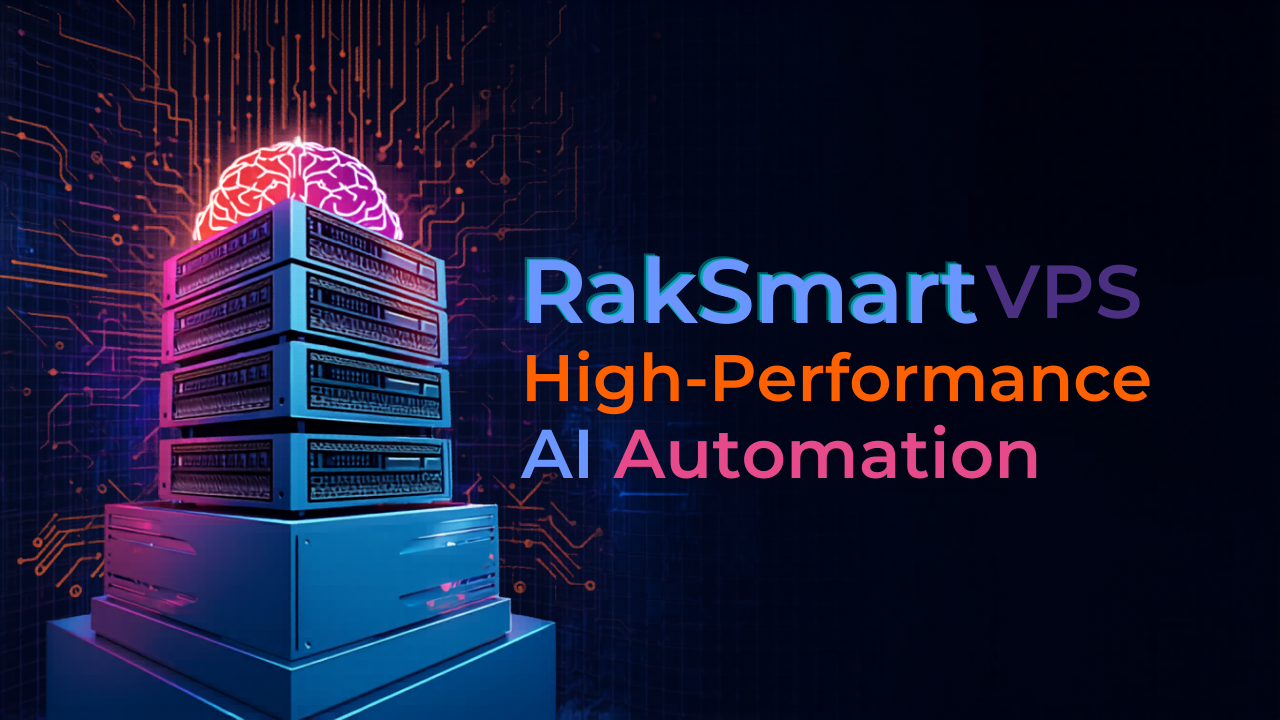
AI automation is rapidly becoming the backbone of modern digital income systems. From content generation to lead processing and workflow automation, tools like OpenClaw are changing how online businesses operate. But what most people overlook is that AI automation does not run on ideas or software alone—it runs on infrastructure. RakSmart VPS has become a key enabler for these systems because it provides the stable, scalable, and cost-efficient environment needed to support continuous AI execution. Without strong hosting, even the most advanced automation system becomes unstable and limited.
AI Automation Is Not Just Software—It Is a System
Most beginners assume AI automation is purely about tools. They focus on prompts, workflows, or AI models. But in reality, AI automation behaves more like a system than a tool.
A system includes:
- input (data, triggers, user actions)
- processing (AI logic, workflows, automation engines)
- output (results, content, actions, decisions)
- infrastructure (servers that keep everything running)
OpenClaw sits in the processing layer, but it cannot function without the infrastructure layer beneath it.
This is where RakSmart VPS becomes essential.
Why Infrastructure Determines AI Performance
AI automation systems are highly resource-dependent. Unlike static websites or simple applications, they require continuous processing power and stable execution environments.
Without proper infrastructure, common issues appear:
- workflows stop mid-execution
- API requests fail under load
- automation becomes inconsistent
- system response slows down over time
These problems are not caused by AI tools—they are caused by weak hosting environments.
RakSmart VPS solves this by providing dedicated system resources that are not shared or throttled by other users.
OpenClaw Requires Continuous Execution Power
OpenClaw is designed for automation workflows that run continuously in the background. This includes:
- multi-step task execution
- real-time data processing
- API integrations
- persistent automation loops
These processes cannot function in short execution windows. They require a stable environment where tasks can run without interruption.
RakSmart VPS provides that environment by allowing:
- long-running processes
- stable memory allocation
- consistent CPU availability
- uninterrupted system uptime
This is critical for maintaining automation reliability.
Why Shared Hosting Fails for AI Automation
Many beginners attempt to run automation systems on shared hosting because it is cheap or familiar. However, shared hosting is not designed for AI workloads.
Its limitations include:
- strict execution time limits
- shared CPU and memory resources
- restricted background processing
- unstable performance under load
When OpenClaw workflows are deployed in such environments, they often break or behave unpredictably.
This is why serious automation builders move to VPS infrastructure early.
RakSmart VPS as an AI Automation Enabler
RakSmart VPS is designed to bridge the gap between affordability and performance. It allows users to deploy AI automation systems without needing enterprise-level infrastructure.
Key advantages include:
- dedicated computing resources for stable execution
- scalable configurations for growing automation workloads
- reliable uptime for continuous workflows
- flexible environment for custom AI systems
This makes it suitable for both beginners and advanced automation builders.
The Connection Between VPS Stability and Income Systems
AI automation is often used for income generation. Whether through affiliate systems, SaaS tools, or content automation, stability directly impacts revenue.
If automation breaks:
- content stops being generated
- leads stop being processed
- workflows fail silently
- revenue becomes inconsistent
RakSmart VPS helps prevent this by ensuring systems run continuously and reliably.
Stable infrastructure leads to stable income systems.
Why Scalability Starts at the VPS Level
Scalability in AI automation is not just about adding more workflows—it is about increasing system capacity.
RakSmart VPS allows scaling through:
- upgrading CPU and memory resources
- running multiple automation systems simultaneously
- distributing workloads across environments
- maintaining performance under increased demand
This makes it possible to grow from a single automation setup into a full AI-powered business system.
The Hidden Advantage: Cost Efficiency for Experimentation
One of the most powerful advantages of RakSmart VPS is cost efficiency. AI automation systems often require experimentation before they become profitable.
Low-cost infrastructure allows users to:
- test multiple automation ideas
- iterate quickly without financial pressure
- build systems gradually
- scale only what works
This reduces risk and increases innovation speed.
Conclusion: Infrastructure Is the Real AI Advantage
AI automation success is not determined by tools alone—it is determined by infrastructure quality. OpenClaw provides the intelligence layer, but RakSmart VPS provides the execution foundation that makes automation stable, scalable, and profitable.
Without VPS infrastructure, AI automation remains fragile. With it, it becomes a structured income system capable of scaling over time.
RakSmart VPS is not just hosting—it is the operational backbone of modern AI automation.
FAQ
1. Why is VPS necessary for AI automation systems like OpenClaw?
Because AI automation requires continuous execution, stable resources, and long-running processes that shared hosting cannot support reliably.
2. Can OpenClaw run without VPS hosting?
It can run in limited environments, but performance will be unstable and not suitable for scalable automation systems.
3. What makes RakSmart VPS suitable for AI automation?
It provides dedicated resources, stable uptime, and flexible scalability needed for automation workflows.
4. Does VPS improve AI system reliability?
Yes, because it eliminates resource competition and ensures consistent system performance.
5. Is VPS important for making money with AI automation?
Yes, because income systems depend on stability, uptime, and continuous execution.