Overview
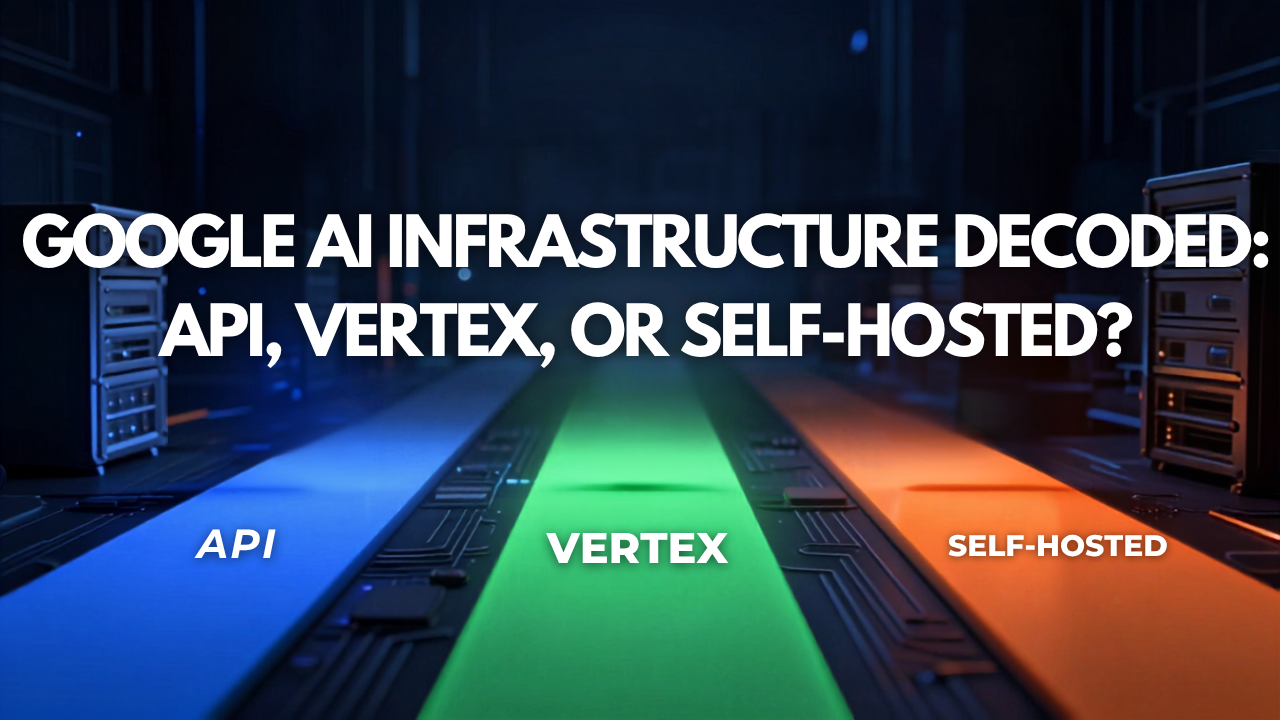
The “Google AI” ecosystem is not a single product but a spectrum of services, from instant API access to full-fledged machine learning platforms. Your primary decision is to match your specific workload—whether it’s rapid prototyping, integrated model training, or high-throughput inference—to the correct infrastructure tier: the Gemini API, Vertex AI, or a self-hosted bare metal server. This guide provides a clear framework to make that choice based on technical requirements, operational control, and total cost.
What Are the Core Components of the Google AI Ecosystem?
Google AI is delivered through three distinct product tiers: the Gemini API for direct model access, Vertex AI for end-to-end ML platform management, and the underlying Google Cloud infrastructure which can host custom models. Understanding the purpose of each layer is the first step in choosing your path.
- The Gemini API: This is a managed, stateless API service. Developers send requests (e.g., text prompts, image data) and receive responses from Google’s flagship Gemini models. It requires zero infrastructure management and scales on-demand, with costs directly tied to usage.
- Vertex AI: This is Google Cloud’s comprehensive machine learning platform. It allows data science teams to use Google’s pre-trained models or to build, train, deploy, and manage their own custom models on Google’s managed infrastructure. It provides a full suite of tools for the ML lifecycle.
- Self-Hosted Bare Metal: This involves deploying open-source models (like Llama, Mistral, or your own fine-tuned models) on dedicated GPU servers you control, whether from a cloud provider or an infrastructure partner like RAKsmart. This path prioritizes predictable costs, hardware control, and data sovereignty.
When Should I Use the Gemini API vs. Vertex AI?
Use the Gemini API for stateless, application-level features; choose Vertex AI when you need to build, train, or manage custom models with integrated tools. The choice hinges on whether you are consuming a model or developing a model.
| Feature | Gemini API | Vertex AI Platform |
|---|---|---|
| Primary Use Case | Adding AI capabilities to apps (chatbots, content generation, analysis). | Building, training, and deploying custom ML models. |
| Model Access | Access to Google’s latest Gemini models only. | Google models + the ability to train/deploy your own models. |
| Infrastructure Control | None. Fully managed by Google. | Moderate. You manage code and pipelines, but Google manages hardware. |
| Key Tools | RESTful API endpoints, SDKs. | Data labeling, managed training, MLOps pipelines, model registry. |
| Cost Model | Pay-per-request or token. | Pay for compute resources (training hours, serving nodes) + platform fees. |
When Does a Self-Hosted Dedicated Server Become the Right Choice?
A dedicated server is optimal when your workload demands fixed monthly costs, strict data control, or when the cumulative expense of API calls or cloud compute surpasses the cost of leasing hardware. Consider this path for:
- High-Volume, Predictable Inference: Serving millions of requests daily for a fine-tuned model has a high, variable API cost. A dedicated server with appropriate GPUs (e.g., NVIDIA RTX 4090 for many workloads) offers a flat monthly fee.
- Model Training and Fine-Tuning: Training jobs run on cloud compute (like Vertex AI Training) incur hourly costs that can become substantial. Leasing a server with NVIDIA A100 or H100 GPUs for an indefinite period can be more economical for continuous training.
- Data Sovereignty: Processing sensitive data that cannot leave your physical premises or a specific country requires infrastructure you directly control.
- Advanced Optimization: Running workloads that need specific OS kernels, driver versions, or hardware configurations not supported by managed services.
How Do I Match My Workload to the Right Google AI Product?
Map your project’s primary function to a product: use the Gemini API for application features, Vertex AI for custom model development, and dedicated servers for high-volume inference or specialized training.
- Building a SaaS App with AI Features? Start with the Gemini API. It’s the fastest way to add summarization, generation, or analysis without DevOps overhead.
- Developing a Proprietary AI Model? Use Vertex AI. Its integrated tools for data preparation, training, and deployment streamline the complex ML lifecycle.
- Serving a Trained Model to Millions? Evaluate a self-hosted dedicated server. If your inference volume is high and stable, the fixed cost of a dedicated GPU server will likely beat variable API or cloud fees.
- Researching or Experimenting with Model Architectures? A self-hosted environment gives you full control over the software stack, crucial for reproducibility and performance tuning.
What is the Total Cost of Ownership Comparison?
Total cost isn’t just the API bill or server lease; it includes egress fees, engineering time, and scaling overhead. Here’s a breakdown:
| Cost Factor | Gemini API | Vertex AI | Self-Hosted Bare Metal |
|---|---|---|---|
| Compute Cost | Variable (per token/request). | Variable (per GPU/hour for training, per node for serving). | Fixed (monthly server lease). |
| Network Egress | Google Cloud egress fees apply. | Google Cloud egress fees apply. | Often included in lease; can be zero. |
| Engineering Overhead | Low (API integration). | Medium (MLOps pipeline management). | High (server setup, security, maintenance). |
| Scalability Cost | Instant, but costs scale linearly. | Scalable, but requires managing new nodes. | Requires provisioning new physical servers. |
| Peak Demand Handling | Handled by Google, costs spike with usage. | Requires autoscaling configuration. | Fixed capacity; requires over-provisioning. |
The Break-Even Insight: Calculate your estimated monthly API tokens or Vertex AI compute hours. Compare that projected bill to the fixed monthly cost of a dedicated server with equivalent GPU power. If the server cost is lower and you have the team to manage it, self-hosting is the more economical choice.
What Role Does Server Location Play in Google AI Performance?
Physical proximity reduces latency for both API calls and self-hosted model serving. For applications using the Gemini API, hosting your application server in a data center with high-speed peering to Google’s network minimizes round-trip time. For self-hosted models, placing your server in a major hub like Los Angeles, Tokyo, or Frankfurt ensures low-latency access for your primary user base. Providers with global data center footprints, such as RAKsmart, enable this strategic placement.
Decision Framework: Choosing Your Google AI Path
Use this checklist to guide your evaluation:
- Define Your Core Task: Are you consuming a pre-built model, developing a custom model, or deploying a trained model at scale?
- Quantify Your Volume: Estimate monthly API calls, tokens, or required GPU hours for training/inference.
- Analyze Your Data: Does your data have residency restrictions or sensitivity that prevents using public cloud APIs?
- Assess Your Team: Do you have DevOps/MLOps engineers to manage servers and ML pipelines?
- Run the Cost Model: Project your costs for 6-12 months under each potential path, including hidden fees like egress and engineering time.
- Test with a Pilot: If unsure, prototype your feature with the Gemini API first. If the cost or limitations become prohibitive, then explore migration to a self-hosted solution.
FAQ
Can I run Google’s proprietary Gemini models on my own server?
No, the Gemini models are proprietary and only accessible via the Gemini API or within the Vertex AI managed environment. You cannot download and run them on your own infrastructure. For self-hosting, you must use open-source models like Llama, Mistral, or your own fine-tuned versions.
Which option gives me the most control over my AI models and data?
The self-hosted bare metal path offers the highest level of control. You manage the entire stack: hardware, operating system, drivers, and model code. This is essential for strict data sovereignty and deep performance optimization. Vertex AI provides control over model code and data pipelines, while the Gemini API offers the least control, as it is a pure consumption service.
How do I calculate if a dedicated GPU server is cheaper than the Gemini API?
Estimate your monthly token usage and multiply by the API’s per-token price. Then, find the monthly cost of a dedicated server with GPUs (e.g., NVIDIA A100 80GB) capable of handling the same inference load. Compare the two figures, factoring in that the server cost is fixed while the API cost will fluctuate and may include egress fees.
What GPU specifications are critical for self-hosting AI models?
For inference, VRAM is the most critical spec for handling model size. An NVIDIA RTX 4090 (24GB VRAM) is excellent for many 7B-13B parameter models. For larger models (70B+) or training, you need high-VRAM datacenter GPUs like the NVIDIA A100 (80GB) or H100 (80GB).
How do I get started with testing the Gemini API?
You begin by creating a Google Cloud project, enabling the Gemini API, and obtaining an API key. You can then use the provided SDKs or make direct REST API calls to start integrating model capabilities into your application.
Conclusion
Selecting the right Google AI infrastructure is a strategic decision that balances innovation speed, cost predictability, and operational control. For many developers, the Gemini API offers a frictionless start, while Vertex AI empowers data teams building complex, custom models. When workloads become large-scale, predictable, or data-sensitive, a dedicated server provides the fixed costs and hardware control needed for efficient operations. By systematically evaluating your workload against these three tiers, you can deploy a solution that is both performant and economically sound. Explore infrastructure options that align with your chosen path to ensure your AI projects have a robust and scalable foundation.