Overview
For business use, selecting between Claude AI and ChatGPT is less a question of which model is "smarter" and more a strategic decision about your total cost of ownership (TCO), operational model, and long-term infrastructure strategy. The optimal choice depends on whether your priority is managed-service convenience, integrated cloud ecosystem governance, or maximum control and data sovereignty through self-hosted infrastructure.
What Are the True Cost Components Beyond API Token Pricing?
The direct API token cost is only one component of the total cost. A comprehensive TCO includes engineering integration time, ongoing maintenance, compliance auditing, and potential vendor lock-in. Both providers offer tiered pricing with discounts for committed use, but the hidden costs of your chosen deployment model often dwarf these fees.
For example, using a fully managed service like Azure OpenAI or Amazon Bedrock reduces initial engineering work but may incur higher platform premiums. Conversely, a direct API approach offers lower per-call costs but requires your team to build and maintain the integration abstraction layer, security controls, and monitoring. The table below breaks down these TCO components across common deployment scenarios.
| Cost Dimension | Managed Cloud Service (e.g., Azure OpenAI, Bedrock) | Direct API (Either Provider) | Self-Hosted Open-Source Model |
|---|---|---|---|
| API Token Cost | Medium-High (includes platform premium) | Low-Medium (pure usage cost) | None (hardware cost is capital expenditure) |
| Initial Engineering | Low (pre-built integrations) | Medium (requires building abstraction layer) | High (full deployment pipeline, optimization) |
| Ongoing Operations | Low (managed scaling, updates) | Medium (your team manages reliability) | High (patching, scaling, security hardening) |
| Compliance Overhead | Medium (leverage provider certs, but audit is still your duty) | High (you own entire audit trail) | Maximum (you are fully responsible) |
| Long-Term Flexibility | Low (high lock-in risk within ecosystem) | High (can switch providers with minimal code change) | Maximum (model agnostic, but infrastructure bound) |
How Do Enterprise Security and Compliance Models Differ?
ChatGPT and Claude offer distinct default security postures. ChatGPT, accessed via Azure OpenAI Service, inherits Azure’s extensive compliance portfolio (e.g., SOC, HIPAA, FedRAMP) and integrates with Azure Active Directory for identity management. Claude’s API from Anthropic, or via Amazon Bedrock, emphasizes safety-focused model design and provides robust API-key-based security; Bedrock integrates with AWS IAM for governance.
Both providers commit to not training on your business data by default, but the specifics of data processing agreements, audit logs, and data residency guarantees differ. For highly regulated industries, you must verify that the provider’s certifications meet your regulatory requirements and understand that the cloud provider’s compliance does not automatically transfer to your application.
What Is the Real Integration Complexity and Lock-in Risk?
The integration complexity lies in building a production-grade pipeline, not just making API calls. A managed service like Bedrock or Azure OpenAI reduces infrastructure overhead but deepens coupling to that cloud provider’s proprietary SDKs, monitoring tools, and billing systems. Switching providers later becomes a significant re-engineering project.
A provider-agnostic approach, where you call OpenAI’s and Anthropic’s standard REST APIs directly, requires more upfront engineering to build a thin abstraction layer. However, this investment pays dividends in flexibility, allowing you to benchmark new models from either vendor with minimal code changes and avoid being locked into a single ecosystem’s price increases or policy shifts.
Which Deployment Model Aligns with Your Long-Term Strategy?
Your deployment choice should match your organization’s primary driver. For teams deeply invested in a cloud ecosystem and valuing integrated governance, starting within that ecosystem (Azure for Microsoft shops, Bedrock for AWS) makes sense. For businesses where avoiding lock-in and maintaining switching flexibility is a strategic goal, a provider-agnostic API layer is essential.
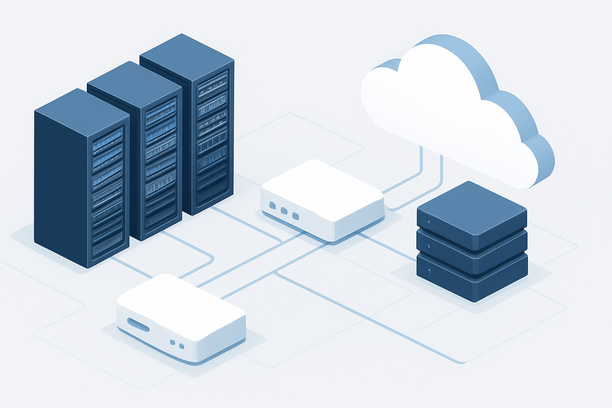
For organizations where absolute data sovereignty and operational control are non-negotiable—common in finance, healthcare, or government—self-hosting a private LLM becomes the critical path. This eliminates third-party data processing but shifts all operational, security, and compliance burdens to your team. It requires dedicated GPU servers and MLOps expertise. For such private deployments, bare-metal infrastructure providers like RAKsmart supply the foundational server hardware necessary to host and manage your own endpoints, giving you full control over the physical and logical environment.
Decision Checklist: Prioritizing Your Business Driver
- If your top priority is minimizing compliance risk and achieving absolute data sovereignty:
- Evaluate the feasibility of self-hosting an open-source LLM (e.g., Llama, Mistral) on dedicated servers in your chosen data center. This is the only path to fully eliminate third-party data access.
- If your team is deeply invested in the AWS ecosystem and values integrated governance:
- Begin your evaluation with Claude on Amazon Bedrock to leverage existing IAM, CloudTrail, and infrastructure patterns.
- If your team is invested in the Microsoft ecosystem and requires Azure-level security certifications:
- Start with ChatGPT via Azure OpenAI Service for native compliance and integration with Microsoft’s security stack.
- If avoiding vendor lock-in and maintaining switching flexibility is a strategic goal:
- Implement a thin, provider-agnostic API client that calls both OpenAI and Anthropic directly via standard REST interfaces.
- If your primary need is rapid proof-of-concept with balanced cost:
- Start with the direct API from either provider using a cost-effective model to validate business value before deeper architectural commitment.
FAQ
How do the base API costs compare for typical business workloads like document processing or customer service chat?
Direct token cost comparison is highly variable based on model version, input/output token volume, and request patterns. Both providers offer tiered pricing, with larger batch or committed-use discounts available. The key is to benchmark with your specific workload data, not just list prices. Remember to factor in the engineering cost of the integration, which can differ significantly.
Which platform offers better built-in compliance certifications for industries like finance or healthcare?
Azure OpenAI Service generally inherits the extensive compliance portfolio of Microsoft Azure (e.g., SOC, HIPAA, FedRAMP). Anthropic and AWS Bedrock have their own strong compliance frameworks, but the specific certifications may vary. You must obtain the current compliance documentation from each provider and map it against your regulatory requirements.
What is a practical strategy for testing both platforms with our proprietary data without creating security risks?
Use a "sandbox" approach. Create a dedicated, anonymized, or synthetic dataset that mirrors the structure and challenges of your real data. Run parallel tests against both APIs from a controlled environment that does not expose sensitive information. This provides performance and quality insights while managing risk.
Can we realistically self-host a model like Llama or Mistral instead of using Claude or ChatGPT for full control?
Yes, self-hosting open-source models is a viable strategy for complete control. The hardware requirements, however, are substantial. For business-grade inference with reasonable latency, you need dedicated servers with high-end GPUs, significant VRAM, and optimized software stacks. This requires in-house or contracted MLOps expertise to manage deployment, scaling, and security patching.
How do we architect an application to switch between Claude and ChatGPT with minimal code changes?
Design an abstraction layer in your application that defines a standard interface for AI tasks (e.g., summarize(), generate()). Implement this interface separately for each AI provider’s API. This isolates provider-specific code and allows you to add new models or switch between them by updating the configuration and implementation of that layer, without rewriting your core application logic.
Conclusion
The decision between Claude AI and ChatGPT for business is ultimately a decision about your operational model. A managed cloud service offers speed and integrated governance at the cost of flexibility and potential lock-in. A direct API approach prioritizes switching power but requires more engineering. Self-hosting delivers absolute control but demands significant infrastructure and expertise. Assess your true priorities—whether they are cost minimization, compliance, flexibility, or sovereignty—and let that guide your deployment choice. For teams considering the path of self-hosted infrastructure to maintain full control, exploring dedicated GPU server options provides the physical foundation necessary for a private AI deployment.