Overview
Integrating ChatGPT AI into an application typically means choosing between three distinct paths: using the OpenAI API directly, routing requests through a management gateway, or running open-source models on your own GPU servers. Each path serves a different priority—simplicity, cost optimization, or full data sovereignty—and selecting the wrong one can lead to unexpected costs, latency issues, or compliance risks. This comparison breaks down the practical trade-offs to help you match your deployment strategy to your actual constraints.
What Are the Primary Ways to Deploy ChatGPT AI?
The three core integration paths cater to different operational philosophies and technical requirements.
Direct API Access involves connecting your application directly to OpenAI's endpoints. You pay per token, receive completions, and are responsible only for prompt engineering and integration logic. This path offers immediate access to the latest models like GPT-4o without managing any infrastructure.
Proxy or Gateway Services act as an intermediary between your application and the model provider. They add a layer for cost control, caching, analytics, and multi-provider management. By optimizing requests, they can reduce overall spending while simplifying vendor management.
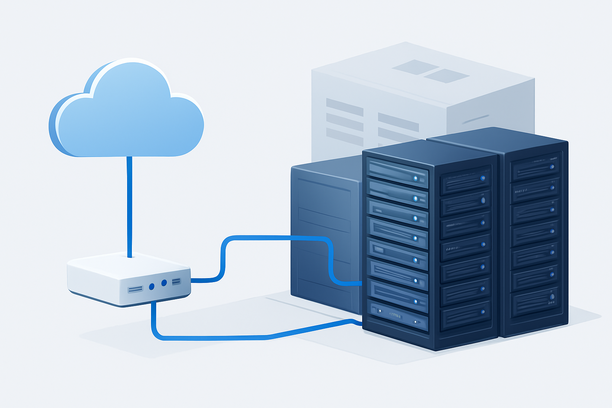
Self-Hosted Open-Source Models run on infrastructure you control, such as dedicated GPU servers. Models like Llama 3 or Mixtral now approach GPT-3.5 quality, and some benchmarks rival GPT-4. This path demands the most operational effort but offers complete control over data and costs at scale.
How Do the Costs Differ Between API, Gateway, and Self-Hosted?
Cost comparison is misleading if you only look at per-token pricing. The three paths use fundamentally different economic models.
The Direct API follows a consumption model. GPT-4o charges roughly $2.50 per million input tokens and $10 per million output tokens, while GPT-4o-mini is far cheaper. This pay-as-you-go approach means zero idle costs, but expenses scale linearly and can spike with complex, token-heavy interactions.
Gateway Services add a small fee or markup to API costs but can reduce total spend through caching repeated queries, compressing prompts, and routing simpler requests to cheaper models. For applications with high query repetition, a well-configured gateway can cut API bills by 30-50%.
Self-Hosted Models invert the equation: you pay a fixed monthly infrastructure cost, typically $200–$800 for an inference-grade GPU server, regardless of token volume. At high scale (millions of tokens daily), this becomes dramatically cheaper per query. At low volume, the fixed cost makes it the most expensive option.
| Deployment Path | Cost Model | Break-even Point (vs. API) | Upfront Investment | Cost Predictability |
|---|---|---|---|---|
| Direct API | Per-token consumption | N/A | None | Low (scales linearly) |
| Proxy Gateway | Token cost + service fee | Volume-dependent | None | Medium |
| Self-Hosted | Fixed monthly infrastructure | ~500K–1M tokens/day | GPU server ($200–$800/mo) | High (fixed) |
Which Path Offers Better Data Privacy for Your ChatGPT AI?
For applications handling sensitive data, privacy often outweighs cost as the deciding factor.
With Direct API Access, prompts and completions transit through OpenAI's servers. While OpenAI does not use customer data for training by default, and enterprise plans include SOC 2 compliance and data retention opt-outs, data still leaves your infrastructure. This may conflict with strict data residency requirements like GDPR or HIPAA.
Gateway Services inherit the privacy posture of the underlying API but add an intermediary. This can enhance security if the gateway offers additional encryption and audit logging, or weaken it if the gateway’s standards are lower. Evaluate providers on their security certifications and data handling policies.
Self-Hosted Models deliver the strongest privacy guarantee: data never leaves your infrastructure. For organizations in healthcare, finance, or government where data sovereignty is non-negotiable, this eliminates an entire category of compliance risk. The trade-off is that open-source models may not match GPT-4's reasoning quality for all tasks.
Why Does Network Latency Matter for Real-Time ChatGPT AI Applications?
For real-time use cases—chatbots, coding assistants, live translation—latency directly determines whether users stay engaged. Research shows that response delays exceeding three seconds cause measurable drops in user retention.
Direct API latency depends on your network path to OpenAI's servers. GPT-4o typically delivers first tokens within 200–500ms via streaming, but geographical distance plays a significant role. Users in Asia accessing US-based endpoints often face higher latency due to standard international routing.
Gateway Services can improve perceived latency through response caching and edge deployment. However, non-cached requests may incur an additional network hop, adding 10–50ms of latency.
Self-Hosted Models eliminate external network dependencies. When your GPU server is geographically close to your users, streaming latency can drop below 50ms. The quality of the network path matters as much as distance; optimized routes using dedicated backbone connections reduce jitter and packet loss, which is critical for consistent streaming performance during peak hours.
How Do Scalability and Maintenance Requirements Compare?
Each approach demands different operational capabilities from your team.
Direct API requires minimal operations. There is no infrastructure to manage, no models to update, and OpenAI handles scaling automatically. Your team focuses on application logic. The downside is vendor lock-in on OpenAI's availability, pricing, and API stability.
Gateway Services need moderate operational investment. You manage gateway configuration, monitor costs, and handle gateway-specific failure modes. The benefit is reduced lock-in, as many gateways support multiple providers through a unified interface.
Self-Hosted Models demand the most engineering capacity. Your team handles GPU provisioning, model deployment and updates, inference optimization, monitoring, and hardware lifecycle management. This requires dedicated infrastructure expertise but provides maximum control over your AI stack.
Decision Framework: Which ChatGPT AI Path Fits Your Project?
Work through this checklist top to bottom. The first decisive answer usually determines your best path.
- Does your data fall under strict regulatory requirements (HIPAA, GDPR data residency, government classification)?
- Yes → Self-hosted is likely mandatory. Evaluate open-source models against your quality thresholds.
- No → Continue below.
- Is your team's primary mission shipping product features, not managing infrastructure?
- Yes → Direct API or gateway. Avoid self-hosting operational burden unless your scale demands it.
- No → Self-hosted may be viable if you have dedicated infrastructure engineers.
- Is your daily token volume consistently above 500,000 tokens?
- Yes → Self-hosted becomes cost-competitive. Calculate your exact break-even point.
- No → API-based solutions deliver better economics at lower volumes.
- Do you need to switch between providers or run multiple models?
- Yes → Gateway service provides unified management and failover flexibility.
- No → Direct API is simpler with fewer moving parts.
- Is sub-50ms streaming latency critical for your user experience?
- Yes → Self-hosted on infrastructure geographically close to your users, with optimized network routing.
- No → API streaming latency satisfies most application requirements.
For teams whose evaluation points toward self-hosted infrastructure, providers like RAKSmart offer GPU-equipped dedicated servers suitable for open-source model inference, with network configurations optimized for low-latency access across multiple regions.
FAQ
Can I fine-tune GPT-4 through the OpenAI API?
OpenAI offers fine-tuning for GPT-4o-mini and GPT-3.5 Turbo, but fine-tuning for GPT-4 and GPT-4o remains limited to select enterprise customers. If you need domain-specific behavior, evaluate whether fine-tuned smaller models meet your quality bar, or whether effective prompt engineering with the base model is sufficient.
How does a proxy gateway actually reduce ChatGPT AI costs?
Gateways cut costs through request caching, prompt compression, and model routing. By storing responses for identical prompts, shortening inputs while preserving intent, and automatically sending simpler requests to cheaper models, they reduce the total number of premium API calls. Applications with high query repetition see the largest savings.
What GPU hardware do I need to self-host a ChatGPT-quality model?
Running Llama 3 8B (comparable to GPT-3.5 quality) requires a single NVIDIA A10 or RTX 4090 with 24GB VRAM. For Llama 3 70B (approaching GPT-4 quality on many tasks), plan for two to four A100 80GB GPUs, with infrastructure costs typically ranging from $500 to $2,000 monthly.
Is sending sensitive data through the OpenAI API actually safe?
OpenAI's API does not use customer data for training by default, and enterprise customers receive SOC 2 compliance guarantees plus data retention opt-outs. However, for data subject to HIPAA, government classification, or strict residency mandates, self-hosted deployment may be the only compliant path. Always involve your compliance team.
Can I combine multiple ChatGPT AI deployment paths in one application?
Yes, and production systems frequently do. A common pattern uses the OpenAI API as the primary provider while maintaining a self-hosted fallback model for high-availability scenarios. Gateway services can automate this failover, routing requests to a backup provider when the primary API returns errors or exceeds latency thresholds.
Conclusion
The right ChatGPT AI deployment path depends on your specific constraints around budget, data sensitivity, performance targets, and team capacity. Direct API access excels on simplicity and model quality. Gateway services win on cost optimization and multi-provider flexibility. Self-hosted models deliver unmatched data control and long-term cost efficiency at scale.
Start by auditing your actual token volume, data classification level, and latency requirements. Map these against the decision framework above to arrive at a strategy that serves your application today without locking you into a path that cannot scale tomorrow. If your requirements point toward self-managed infrastructure, explore RAKSmart's GPU server plans configured for AI inference workloads and optimized for your target user regions.