
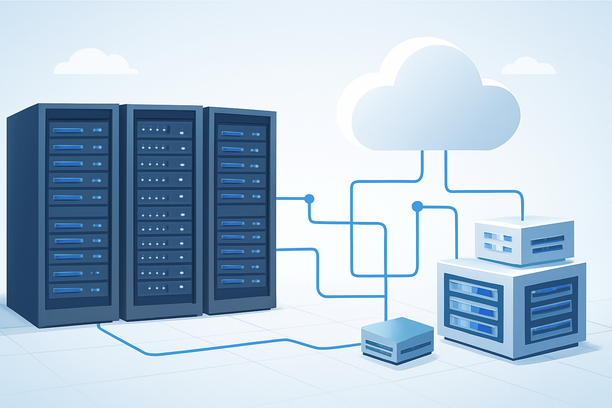
Deploying a ChatGPT-compatible service or any large language model (LLM) inference endpoint requires a fundamental infrastructure decision: rent a dedicated server or provision a cloud GPU instance. This comparison moves beyond raw hardware specs to analyze the practical trade-offs in performance consistency, operational control, and total cost of ownership (TCO) for production AI workloads.
Why is a dedicated server a relevant option for AI inference?
A dedicated server provides exclusive, non-virtualized access to physical hardware, eliminating the performance variability (noisy neighbors) common in shared cloud environments. For sustained, high-utilization inference tasks like serving a ChatGPT API, this translates to more predictable latency and throughput, forming the foundation of a stable user experience.
The decision to choose a dedicated server over cloud GPU hinges on workload predictability and the value of control. If your model inference generates consistent, around-the-clock traffic, the economics of a dedicated server become compelling. Cloud GPU instances excel for variable workloads, rapid experimentation, and short-term projects where paying a premium for on-demand flexibility is justified.
What are the core comparison dimensions for AI server hardware?
The primary factors are GPU compute and memory, network performance and topology, and the server management model (bare metal vs. virtualized). Each dimension directly impacts the final performance and cost of your AI service.
GPU and Memory: The Engine of Inference
For LLM inference, GPU Video RAM (VRAM) is paramount. It determines the maximum model size you can load without resorting to slower disk offloading.
- Cloud GPU Instance: Offers a menu of virtualized GPUs (e.g., NVIDIA A100, L40S). Specifications are standardized, but you share the physical GPU's compute time via NVIDIA's MPS or time-slicing in some cases, potentially adding noise.
- Dedicated Server: Provides a physical GPU installed directly in your leased machine (e.g., NVIDIA A100 80GB, H100). You have exclusive access to all its cores and memory, guaranteeing full, undisputed compute cycles for your workload.
Network: The Path for User Interaction
Network quality dictates user-perceived latency. A cloud instance is networked within the provider's ecosystem, offering low latency to other services but variable public internet egress. A dedicated server's performance depends on its data center's peering.
- Cloud: Excellent internal network for connecting databases or microservices. Public network latency to end-users is managed by the provider but can be costly at scale.
- Dedicated Server: Performance is defined by the host's upstream connectivity. A server in a data center with direct peering to major internet exchanges can deliver lower latency to global users. High-bandwidth options, like dedicated servers with 1G or 10G uplinks, ensure the network never bottlenecks your GPU.
Management and Control: The Operational Overhead
This is the most significant philosophical difference.
- Cloud: Abstracts away hardware failures. If a GPU node dies, the platform migrates your instance. You manage only the software stack (OS, drivers, model). This reduces operational burden but limits deep hardware tuning.
- Dedicated Server: You manage the entire stack. This includes driver installation, kernel tuning, and hardware recovery. A critical tool is the Baseboard Management Controller (BMC), which provides out-of-band access for power cycling, remote console (VNC), and OS reinstallation even during a crash. As detailed in RAKsmart's documentation, a BMC allows for tasks like a "BMC Reset" to recover from configuration issues without physical access.
Direct Comparison: Dedicated Server vs. Cloud GPU for AI
| Feature | ChatGPT AI Dedicated Server | Cloud GPU Instance | Winner for Sustained AI Inference |
|---|---|---|---|
| Performance Predictability | High. Full, dedicated hardware. No "noisy neighbors." Consistent latency and throughput. | Variable. Depends on host contention and virtualization overhead. | Dedicated Server |
| Total Cost of Ownership (TCO) | Lower at High Utilization. Fixed monthly cost. No egress fees. Predictable. | Higher. Pay-per-hour plus costly data egress. TCO rises sharply with constant use. | Dedicated Server |
| Flexibility & Scalability | Low. Scaling requires purchasing or leasing new hardware. Long provisioning time. | High. Spin up/down instances in minutes. Scale GPU count on demand. | Cloud |
| Operational Control | Total. Direct access to BIOS, drivers, kernel, and hardware (via BMC). Optimize for your specific model. | Limited. Abstracted hardware. Constrained by provider's supported OS/images. | Dedicated Server |
| Hardware Selection | Specific. You know the exact GPU model and server chassis. Can choose optimal configuration. | Generic. Provisioned from a pool (e.g., "A100 80GB"). Exact physical unit unknown. | Dedicated Server |
| Reliability & Recovery | Provider-assisted. You are responsible for software recovery. BMC is your lifeline for hardware issues. | Platform-managed. Hardware failures are typically handled by the provider with minimal downtime. | Cloud |
Technical Rationale: Why Bare Metal Tuning Matters for LLMs
Operating on a dedicated server grants direct access to the hardware, which is critical for squeezing maximum performance from an inference workload. You can perform optimizations unavailable or less effective in virtualized environments:
- CPU and Process Pinning: Use
tasksetorcgroupsto pin inference processes to specific CPU cores, eliminating context-switching latency that can disrupt token generation. - Direct GPU Control: Use
nvidia-smito set power limits, compute modes, and monitor real-time utilization without a virtualization layer obscuring the view. - Kernel and Network Stack Tuning: Adjust TCP buffer sizes, congestion control algorithms (like BBR), and interrupt affinity to minimize network latency between your API server and users.
- Driver and Firmware Control: Install the exact CUDA, cuDNN, and driver versions required for your model framework, without compatibility concerns with a shared host OS.
This granular control directly addresses the "hidden variable" of network and system overhead that can bottleneck even the most powerful GPU.
Decision Framework: Choosing Your Deployment Model
Use this checklist to align your infrastructure choice with your project's reality.
Choose a Dedicated Server if:
- Your AI service has a predictable, steady-state workload (e.g., a production API with consistent traffic).
- Latency consistency and raw throughput per dollar are your top priorities.
- You have the technical skill (or team) to manage OS, drivers, and basic hardware troubleshooting.
- You want to avoid unpredictable cloud egress fees and cost spikes.
Choose a Cloud GPU Instance if:
- Your workload is experimental, bursty, or has extreme variable scaling needs.
- Speed to market and rapid iteration outweigh long-term cost efficiency.
- You lack in-house expertise to manage physical server operations and recovery.
- You require geographic deployment flexibility to spin up GPUs in multiple regions temporarily.
Where to Evaluate Dedicated Server Options
When selecting a provider for a dedicated AI server, examine the transparency of their hardware specifications and the quality of their network. Providers offering clear details on GPU models, data center locations, and network peering are preferable. RAKsmart, for instance, presents various dedicated server configurations, including options with high-bandwidth allocations (1G and 10G deals) and multi-IP setups, which can be useful for running separate endpoints or services. For budget-conscious projects, their dedicated server flash sales may offer favorable entry points.
Conclusion: Align Infrastructure with Workload
The comparison between a ChatGPT dedicated server and a cloud GPU instance is ultimately a trade-off between control/cost predictability and flexibility. For a stable, high-throughput AI inference service, the dedicated server's predictable performance, lower TCO, and tuning capabilities make it a technically and economically superior choice. Cloud GPU instances remain the optimal path for development, testing, and highly elastic applications. Begin by evaluating your workload's predictability and your team's operational capacity to make the right foundational choice.
Frequently Asked Questions
Does a dedicated GPU server always perform better than a cloud GPU?
Not "always," but "consistently." A dedicated server guarantees you 100% of a physical GPU's resources, leading to more predictable performance over time. A cloud GPU may perform similarly at any given moment, but its performance can degrade slightly under heavy load on the same physical host. For latency-sensitive, 24/7 inference, the dedicated server's consistency is the key advantage.
How significant are network egress costs compared to a dedicated server's flat fee?
This can be the deciding factor for cost. Cloud providers charge per GB for data leaving their network. For a ChatGPT service where every API response contains generated text, these fees accumulate rapidly. A dedicated server typically includes a substantial bandwidth allocation (e.g., 10TB/month) with unmetered or overage charges being far more predictable and often lower at scale.
What is the primary operational risk of choosing a dedicated server?
The primary risk is hardware failure recovery. With a cloud instance, the provider handles hardware replacement. On a dedicated server, you depend on your provider's hardware support SLA and, critically, on having remote management access (BMC/IPMI) to troubleshoot and recover the system yourself if the OS becomes unresponsive.
Can I use a dedicated server for both training and inference?
Yes, but with caveats. Training is typically an intermittent, high-intensity workload, while inference is often a continuous, steady-state task. A single server can be used for both, but you may encounter contention if training and inference run simultaneously. A better strategy might be to use a dedicated server for primary inference and burst training to cloud instances when needed.
How do I monitor the health of a dedicated AI server I manage?
You must implement your own monitoring stack. Key tools include the BMC/IPMI interface for hardware alerts (temperature, fan speed, power), nvidia-smi for GPU metrics, and software like Prometheus with Grafana or Datadog for system and application performance. Logs from your inference framework (e.g., vLLM, TGI) are also essential for tracking tokens per second and latency.