Overview
When selecting between Claude AI and ChatGPT for business applications, the decision transcends model capabilities and centers on your operational model, infrastructure requirements, and strategic priorities for control versus convenience. The right choice depends on whether you prioritize rapid deployment through a managed service, deep integration within a cloud ecosystem, or absolute data sovereignty via self-hosted infrastructure.
What Are the Core Model Differences Relevant to Business Use?
Claude AI, developed by Anthropic, is designed with a primary focus on safety, helpfulness, and honesty, often resulting in more cautious and nuanced outputs for sensitive content. ChatGPT, from OpenAI, generally prioritizes broad capability and creative generation, with a more extensive plugin ecosystem for added functionality. For business use, these philosophical differences translate into practical trade-offs: Claude may be preferable for roles requiring strict adherence to guidelines and lower hallucination risk (e.g., compliance document review), while ChatGPT’s flexibility and tool integration can accelerate development in applications like custom customer service bots or content generation pipelines.
How Do Their Deployment and Hosting Architectures Differ?
ChatGPT is primarily offered as a managed service through OpenAI’s API, with deep integration into cloud ecosystems via Microsoft Azure OpenAI Service or Amazon Bedrock. Claude is available directly through Anthropic’s API and also via Amazon Bedrock. This shared availability on Bedrock creates a direct comparison point. Your deployment choice fundamentally alters your cost structure, control, and operational overhead.
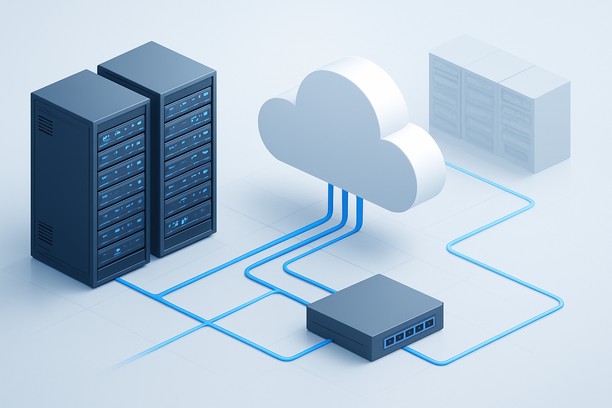
For maximum control and data sovereignty, organizations with stringent compliance needs often consider self-hosting open-source large language models (LLMs) like Llama or Mistral. This approach eliminates third-party API dependency but requires significant in-house or contracted MLOps expertise and dedicated GPU server infrastructure to manage deployment, scaling, and security. Providers like RAKsmart supply the dedicated GPU servers necessary for such private deployments, giving you full control over the physical and logical environment.
Which Deployment Model Aligns with Your Operational Priorities?
Your operational priority should dictate your deployment path. The following table compares common scenarios to guide your architecture decision.
| Operational Priority | Recommended Deployment Path | Key Trade-off |
|---|---|---|
| Rapid Prototyping & Speed to Market | Direct API from OpenAI or Anthropic. | Lowest initial engineering cost; higher long-term integration and potential lock-in. |
| Integrated Cloud Governance | Managed Service (Azure OpenAI, AWS Bedrock). | Leverages existing cloud IAM/compliance; higher platform premium and ecosystem lock-in. |
| Maximum Control & Data Sovereignty | Self-Hosted Open-Source LLM on Dedicated GPU Servers. | Complete data privacy; highest engineering, operational, and infrastructure cost. |
| Balanced Flexibility & Cost | Provider-Agnostic API Layer. | Avoids single vendor lock-in; requires building and maintaining an abstraction layer. |
How Do Enterprise Security and Compliance Models Compare?
Security and compliance are non-negotiable for business deployment. ChatGPT via Azure OpenAI inherits Azure’s extensive compliance portfolio (SOC, HIPAA, FedRAMP) and integrates with Azure Active Directory for identity governance. Anthropic’s direct API uses robust API key security, and when accessed via AWS Bedrock, it benefits from AWS IAM, CloudTrail, and a strong compliance framework.
Both providers contractually commit not to train on your business data by default. However, the specifics of data residency, audit log access, and shared responsibility models vary. You must verify that the provider’s certifications align with your regulatory requirements, as the cloud provider’s compliance does not automatically cover your application’s usage.
What Are the Real Integration Complexities and Lock-in Risks?
Integration complexity lies in building a production-grade pipeline, not just making API calls. Managed services reduce infrastructure overhead but deepen coupling to that provider’s proprietary SDKs and billing systems. Switching later becomes a significant re-engineering effort. A provider-agnostic approach, where your application calls standard REST APIs directly, requires more upfront engineering to build an abstraction layer. This investment pays dividends by allowing you to benchmark and switch between models with minimal code changes, reducing vendor lock-in risk.
Decision Framework: Choosing Your Path
- If absolute data privacy and control over the inference environment are your top priority: Self-host a private LLM on dedicated infrastructure. This eliminates third-party data processing but demands MLOps expertise for operations, scaling, and security patching.
- If your primary goal is leveraging existing cloud investments and integrated governance: Begin with the respective cloud provider’s managed service (Azure OpenAI for Microsoft shops, Bedrock for AWS). This minimizes new operational models but increases ecosystem dependency.
- If maintaining vendor flexibility and long-term negotiating power is a strategic goal: Develop a thin, provider-agnostic API client that interfaces with both OpenAI and Anthropic’s standard APIs. This maximizes switching options.
- If you need the fastest path to a proof-of-concept: Use the direct API from the provider whose model best fits your initial use case. Focus on validating business value before committing to deeper architectural patterns.
FAQ
Can I switch from ChatGPT to Claude later without rewriting our entire application?
Yes, but with caveats. If you built your application using a provider-agnostic abstraction layer that calls standard REST APIs, switching the backend model is primarily a configuration change. If you built tightly coupled integrations using provider-specific SDKs (e.g., Azure OpenAI libraries), migration will require significant code refactoring.
How does the pricing model for Claude AI compare to ChatGPT for a high-volume business application?
Both use token-based pricing with volume discounts. Direct comparisons are complex as pricing tiers, model versions, and output vs. input token costs differ. You must benchmark with your actual workload data. A managed cloud service (like Bedrock) includes a platform premium, while direct API calls have lower base costs but require you to manage the integration layer.
For industries like healthcare or finance, which platform offers better compliance out of the box?
Azure OpenAI Service inherits the extensive compliance certifications of Microsoft Azure. AWS Bedrock, which offers Claude, also has a strong compliance posture. The "better" choice depends on which specific certifications (e.g., FedRAMP, HITRUST, PCI DSS) are mandatory for your use case and which platform you can most effectively govern with your existing compliance team.
Is it realistic to self-host an open-source LLM like Llama to avoid both Claude and ChatGPT?
It is realistic for organizations with the required technical resources. Self-hosting provides complete control over data and infrastructure. The barriers are high: you need dedicated GPU servers with substantial VRAM, a robust MLOps pipeline for deployment and updates, and expertise in model fine-tuning and security hardening to achieve production-grade performance.
How should we approach network performance when deploying an AI-driven application for global users?
Network latency directly impacts user experience. For a globally distributed user base, a multi-deployment strategy is optimal. You can leverage a managed service’s global regions or deploy your private inference endpoints in multiple data centers close to your user concentrations. The choice of server provider and data center location becomes critical for ensuring low-latency inference.
Conclusion
The choice between Claude AI and ChatGPT is a strategic decision about your business's operational model. A managed service offers speed and integrated governance, a direct API provides balanced flexibility, and a self-hosted model guarantees maximum control at the highest operational cost. Assess your priorities for speed, control, compliance, and long-term flexibility. For organizations that determine a private, self-hosted infrastructure path is necessary, exploring dedicated GPU server options from providers like RAKsmart can provide the foundational control required for this deployment model.