Overview
Deploying an AI chat application successfully on a cloud server begins long with the first command; it starts with a structured pre-deployment plan that matches your model's requirements to the right infrastructure, establishes secure recovery paths, and designs for production from day one. This article provides a decision-centric framework, shifting focus from the deployment steps themselves to the critical planning and infrastructure selection that ensures those steps lead to a stable, scalable, and recoverable service.
Why Does Infrastructure Choice Dictate Your Deployment's Ceiling?
The server you provision fundamentally determines your application's performance limits, cost profile, and operational complexity. For an AI chat workload, the primary bottleneck is typically GPU memory and compute throughput for model inference, followed by network quality for API response latency. Choosing a server without mapping your specific model's VRAM footprint (e.g., a 7B vs. a 70B parameter model) and expected concurrent user load leads to either over-provisioning costs or performance degradation.
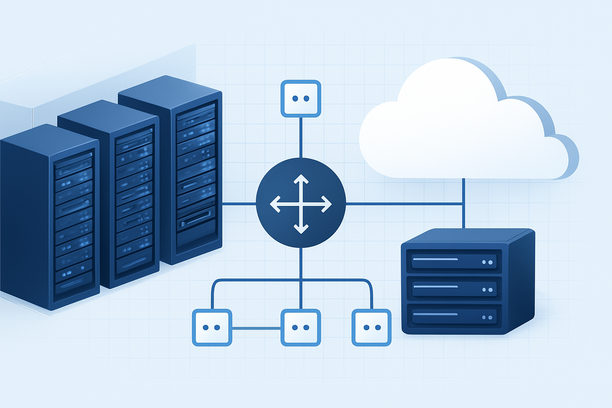
A practical comparison of common infrastructure choices illustrates the trade-offs:
| Infrastructure Type | Best For | Key Advantage | Key Constraint |
|---|---|---|---|
| CPU-only VPS | API orchestration, lightweight models, frontend hosting | Lowest cost, rapid provisioning | Unsuitable for running LLMs directly; high inference latency |
| GPU Cloud Instance | Running medium to large models (e.g., 13B-70B parameters) | Scalable GPU resources, pay-as-you-go flexibility | Cost can escalate quickly with prolonged use; network latency to model |
| Bare Metal with GPU | Running large models, max throughput, strict data control | Peak performance, predictable cost, full hardware control | Requires more administrative effort; longer provisioning/reset times |
| Serverless Containers | Spiky, event-driven inference workloads | No server management, automatic scaling | Cold start latency, limited GPU control, potential vendor lock-in |
For most developers deploying a standard conversational AI model, a GPU cloud instance provides the best initial balance of power and flexibility. Providers like RAKsmart offer bare metal and cloud options that can accommodate the full range from prototype to high-scale production, allowing you to start with a scalable cloud instance and migrate to dedicated hardware as your user base grows.
How Do You Secure Your Server Access Before Disaster Strikes?
The most overlooked step in any deployment is establishing redundant, out-of-band recovery access. A single misconfigured firewall rule or failed package update can lock you out of your primary SSH or RDP connection, halting your operation entirely.
Your recovery plan must be in place before you apply strict security rules. This involves:
- Verifying VNC/Console Access: Immediately after server provisioning, log in to your hosting provider's control panel and test the VNC console. This provides direct, hardware-level access that bypasses the network stack. As detailed in guides like the Bare Metal Cloud VNC Console User Guide, this console is your lifeline.
- Establishing a Recovery Workflow: Know the exact procedure for resetting your root/admin password through the provider's interface. The Bare Metal Cloud Password Change and Reset Guide outlines this process clearly.
- Planning for OS Recovery: If a system update corrupts your OS, you need a path to reinstall. Understand your provider's rescue mode and OS reinstallation process beforehand to avoid data loss or prolonged downtime.
What Is the Correct Sequence for Environment Hardening?
Hardening should follow a logical sequence that prevents you from locking yourself out while building security layers. The recommended order is:
- Initial Access & Baseline: Log in via SSH/RDP, change default passwords immediately, and update the OS packages.
- Recovery Access Confirmation: Test and document your VNC console access and password reset capabilities.
- Firewall Configuration: Deploy a firewall (like UFW on Linux) to allow only necessary ports (22/3389 for admin, 80/443 for web traffic). Do not lock down port 22/3389 until you have verified your new, secure SSH key or password works.
- Service Installation: Install required runtimes, NVIDIA drivers, and container engines (Docker).
- Application Deployment: Deploy your services behind the firewall, only exposing the web ports to the public.
How Do You Design for Observability and Scalability from Day One?
Planning for production includes embedding observability and scalability into your initial architecture.
- Observability: Before deployment, decide on a monitoring solution (e.g., Prometheus + Grafana). You must track GPU utilization/temperature, API response latency, and container health. Configure container restart policies (
restart: unless-stopped) and define health checks within your orchestration files (likedocker-compose.yml). - Scalability: Design your application state to be externalized. Store conversation logs and user data in a separate database service rather than on the application server's disk. This makes scaling out to multiple application servers possible. For the inference engine itself, containerized deployments simplify scaling; you can add more GPU instances and place them behind a load balancer as demand grows.
Pre-Deployment Readiness Checklist
Use this framework to ensure your infrastructure is properly planned before beginning deployment.
- Infrastructure Mapping
- Model VRAM and CPU/RAM requirements are quantified.
- Expected concurrent user load is estimated.
- Network quality (latency, bandwidth) for your user base is considered.
- A clear choice between cloud, bare metal, or hybrid is made based on the above.
- Recovery & Access
- Primary SSH/RDP access is secured with key-based authentication or a strong password.
- Out-of-band VNC/Console access has been tested and verified.
- The process for password reset and OS reinstallation is documented.
- An off-server backup of critical configuration files is planned.
- Security Foundation
- Default passwords for OS and all services are changed.
- A basic firewall rule set is defined (allow admin port, web ports).
- A plan for applying security updates is established.
- Observability Plan
- Key metrics to monitor (GPU, CPU, RAM, API latency) are listed.
- A tool for metrics collection and visualization is selected.
- Container restart policies and health checks are defined.
Frequently Asked Questions
Can I use a high-performance CPU-only server for my AI chat app?
You can use a CPU-only server for hosting the application's backend (API, database) and frontend, but you cannot run the actual large language model (LLM) inference on it effectively. CPU inference for models above a few billion parameters is prohibitively slow for real-time chat. The model itself must run on a server with a compatible GPU. A common architecture is a GPU instance for inference and a separate, cheaper CPU instance for the application layer.
What is the most common failure during initial driver setup?
The most frequent issue is a version mismatch between the NVIDIA driver and the NVIDIA Container Toolkit. If the toolkit version is not compatible with the installed driver version, Docker containers will fail to detect and access the GPU. Always start with a clean OS installation, follow the official installation guide precisely for your specific Linux distribution, and verify with nvidia-smi before proceeding to container deployment.
How do I estimate the GPU VRAM I need for my model?
A rough rule of thumb is to account for about 2GB of VRAM per billion parameters for a model in FP16 (half-precision) format. For example, a 7B parameter model will require approximately 14GB of VRAM. However, this increases with larger context windows and batch sizes. Always check the specific documentation for the model architecture and inference engine you plan to use for more precise estimates.
Is bare metal necessary for launching my AI chat app?
For most initial deployments and moderate traffic, a well-provisioned GPU cloud instance is sufficient and more cost-effective. Bare metal becomes advantageous when you need absolute maximum performance, have very high sustained utilization, require direct control over specific hardware, or have strict data residency compliance that precludes virtualization. You can often start in the cloud and migrate to bare metal later as your workload stabilizes.
How can I reduce costs without sacrificing performance for users?
Focus on optimizing inference efficiency. Use model quantization (like GPTQ or AWQ) to reduce VRAM usage, allowing you to use smaller, cheaper GPU instances. Implement aggressive caching for frequent queries. Scale down resources automatically during off-peak hours using scheduling tools. Finally, ensure your application architecture separates the lightweight frontend/backend from the expensive GPU inference engine, so you can scale each independently based on actual load.
Conclusion
A successful AI chat app deployment is built on a foundation of deliberate infrastructure choice and rigorous pre-deployment planning. By mapping your model's technical requirements to the right server, establishing robust recovery mechanisms, and designing for security and observability from the outset, you transform a fragile prototype into a production-ready service. Evaluate the trade-offs between performance, cost, and control to select the path that aligns with your project's stage and goals.
For teams ready to move from planning to execution, exploring a provider that offers a clear path from scalable cloud instances to dedicated bare metal—like RAKsmart's server portfolio—can provide the flexibility to grow your deployment alongside your user base.