
Overview
AI inference server pricing is not a static figure you lock in at purchase; it is a dynamic curve shaped by your deployment model, workload growth, and operational choices. Focusing only on the initial hourly or monthly rate misses the largest cost variable: how your infrastructure expenses scale as your application moves from a low-traffic prototype to a high-volume production service. The most cost-effective solution at 1,000 requests per day often becomes the most expensive at 1,000,000.
What Is the True Scaling Cost of an Inference Server?
The true scaling cost is the total expenditure required to maintain or increase your inference throughput as user demand grows. This includes not just the base hardware fee, but also the incremental costs of upgrades, bandwidth, and operational complexity.
Scaling an inference server is fundamentally different from scaling a web application. Adding CPU and RAM is straightforward; adding GPU compute requires either migrating to entirely new hardware or adopting a new deployment strategy. A setup that handles your initial traffic cheaply may force a costly, disruptive migration as soon as you need to double your capacity.
This is why the cheapest option at launch isn't always the cheapest at scale. A cloud instance might be perfect for validating your model, but running it 24/7 for production can become prohibitively expensive. Conversely, a dedicated server with a high upfront commitment could deliver a lower total cost if your growth trajectory justifies the sustained load.
How Does Your Deployment Model Affect Scaling Costs?
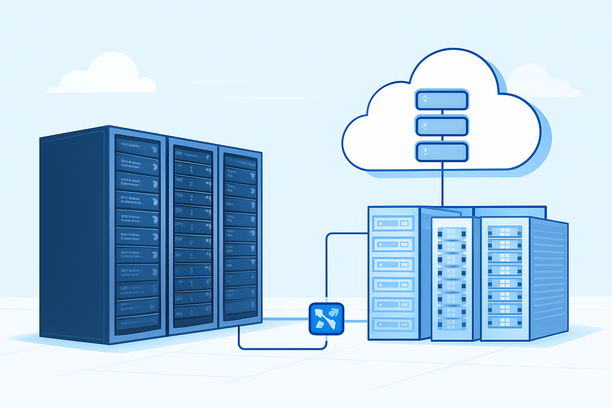
Your initial deployment model—cloud, bare-metal, or API—sets your primary scaling path and its associated cost curve. Each model scales in a distinct way, with different financial and operational implications.
| Deployment Model | Scaling Method | Primary Cost Impact | Best For Scaling When… |
|---|---|---|---|
| Cloud Instance | Vertical (bigger VMs) or Horizontal (more VMs) | Costs increase linearly with instance size or count. Egress fees can compound. | Your traffic is highly variable, and you need instant elasticity. |
| Dedicated Bare-Metal | Hardware upgrade (manual), or load balancing across new servers | Fixed monthly cost jumps significantly upon upgrade. High utilization controls unit cost. | You have predictable, sustained growth and want to control long-term unit costs. |
| API-Based Inference | Automatic, tied to usage | Cost scales linearly with token output. No infrastructure overhead. | Your priority is zero operational burden, and volume is moderate. |
For bare-metal infrastructure, scaling often means a hardware upgrade. This is a planned event with clear cost implications. RAKsmart's guide on how to upgrade or downgrade a bare-metal cloud server details this process, emphasizing the need to back up data, as configurations like CPU, network, and IPs may reset. This process is a discrete cost event, not a continuous expense.
For cloud environments, scaling can be automated but the cost increase is continuous and often includes more than just compute. Network egress—the data flowing out to your users—is a critical scaling cost. A real-time API that streams large inference payloads can see its network bill become a significant portion of its total cost as traffic grows.
When Does a Dedicated Server Become More Cost-Effective Than Cloud?
A dedicated server becomes more cost-effective when your sustained utilization crosses a threshold where the fixed monthly fee is lower than the cumulative hourly cost of an equivalent cloud instance. This is a function of utilization hours per month.
Generally, if your inference workload requires a GPU to be active and available more than 16-18 hours per day (roughly 500-550 hours/month), the economics often shift in favor of dedicated hardware. At that point, you are paying for idle capacity in a cloud model, whereas you have already paid for it upfront with a server.
Consider a simplified model:
- A cloud GPU instance costs $2.50 per hour. Running it 24/7 (720 hours) costs $1,800/month.
- An equivalent bare-metal server costs $1,200/month on a fixed plan.
The break-even point occurs at 480 hours of usage per month ($1,200 / $2.50 per hour). Beyond that, every additional hour on the cloud instance adds pure cost, while the bare-metal cost remains flat. This ignores the potential for promotional pricing, which can alter the calculation significantly. For example, dedicated server flash sales or multi-IP server promotions can lower the fixed monthly fee, making the break-even point even faster to reach. Current offers like the Dedicated Servers Flash Sale should be evaluated against your projected usage.
What Are the Hidden Scaling Costs Most Teams Overlook?
Beyond the advertised price of compute, several secondary costs escalate as you scale, often catching teams off-guard by increasing the total cost of ownership by 20-40%.
- Storage I/O and Capacity: Large models require fast NVMe storage for weights, which is often a fixed, high cost. However, as you scale, you'll accumulate logs, checkpoints, and cache data, requiring more disk space. Expanding storage on a dedicated server isn't always as simple as clicking a button.
- Network Bandwidth and Egress: This is the most underestimated scaling cost. Inference workloads that serve real-time applications (chatbots, API endpoints) generate consistent outbound traffic. Cloud providers charge steep fees for this. With dedicated servers, bandwidth is often included in a package, but exceeding your port's capacity or your plan's transfer limit incurs overage charges.
- Operational Overhead: The labor cost for managing infrastructure doesn't scale linearly. Managing one GPU server is manageable; managing a cluster of five requires significantly more time for monitoring, updates, and troubleshooting. This includes handling system-level issues that arise during software changes, such as recovering desktop access after a critical uninstallation.
- Resilience and Downtime: As your service becomes critical, the cost of unplanned downtime skyrockets. Achieving high availability on dedicated hardware requires investment in redundant power, networking, and backup systems—costs that are included by default in many cloud platforms but are your own responsibility on bare metal.
Decision Framework: Evaluating Your Inference Scaling Path
Use this checklist to audit your current and future needs, ensuring your infrastructure choice aligns with your growth plan.
- Project your 12-month token volume. If growth is steep, model the cost at three points: launch, 6-month mark, and 12-month mark for both cloud and dedicated options.
- Calculate your utilization ratio. Track your planned daily GPU active hours. For sustained loads over 16 hours/day, deeply analyze fixed-cost dedicated options.
- Audit your network profile. Measure expected egress per request. For interactive apps, this can be the dominant cost. Compare cloud egress fees versus included bandwidth on dedicated plans.
- Assess your operational capacity. Scaling a bare-metal setup manually requires DevOps skill. Ensure your team can handle OS reinstalls, driver updates, and hardware troubleshooting if scaling vertically.
- Review provider scaling policies. Before committing, understand the exact process for upgrading hardware with your provider. Some processes are smooth, while others may involve downtime or data migration.
- Factor in resilience needs. If your inference service must be highly available, determine if you need to build redundancy yourself (increasing cost) or can rely on the provider's infrastructure.
Frequently Asked Questions
How do I estimate the total scaling cost for my AI project?
Start by forecasting your request volume over 12 months. Model two scenarios: one using a cloud instance priced hourly, and another using a dedicated server with a fixed monthly fee. Include estimates for network egress, storage, and a portion of engineering time for management. The scenario with the lower total at your projected volume is your more cost-effective path.
Can I scale a bare-metal GPU server without downtime?
Scaling typically requires a hardware change (more VRAM, a faster GPU), which involves a server reboot and potential reconfiguration. The goal is to minimize downtime by having a deployment plan and backups ready. The process is detailed but not instantaneous like adding a cloud instance. Providers like RAKsmart outline their upgrade/downgrade procedures, highlighting the need for data backup.
At what request volume does a dedicated GPU server beat API pricing?
There is no universal number, as it depends on your model's complexity and the API provider's rate card. As a rule of thumb, if your monthly API bill consistently exceeds the cost of leasing a comparable dedicated GPU server, it's time to evaluate self-hosting. This shift involves trading API simplicity for infrastructure management overhead.
How does network latency affect inference pricing and scaling?
Lower latency improves user experience for interactive AI, but achieving it often means deploying closer to users, which may mean more regions and higher complexity. Scaling geographically adds direct cost (more servers) and indirect cost (more management). You must balance the performance benefit against the scaling cost of a multi-region deployment.
What is the biggest hidden cost when scaling an inference server?
For most teams, it is network egress fees. In cloud environments, these fees are often excluded from headline pricing and can grow to be larger than the compute cost itself for high-throughput, real-time applications. On dedicated servers, the equivalent hidden cost is the need to upgrade to a higher-tier network port or exceed a bandwidth package, which is a less frequent but significant expense.
Conclusion
The right inference server pricing model is the one that matches your cost curve to your growth trajectory. A detailed lifecycle analysis reveals that the most economical starting point may create the most expensive scaling bottleneck. By evaluating utilization, projecting volume, and accounting for hidden operational and network costs, you can select a deployment path that remains cost-effective from your first prototype to your millionth user request.
If your analysis points toward a sustained, high-utilization workload, exploring fixed-cost infrastructure options can provide predictable scaling economics. Examining current dedicated server promotions and configuration options is a logical next step in that evaluation.