Overview
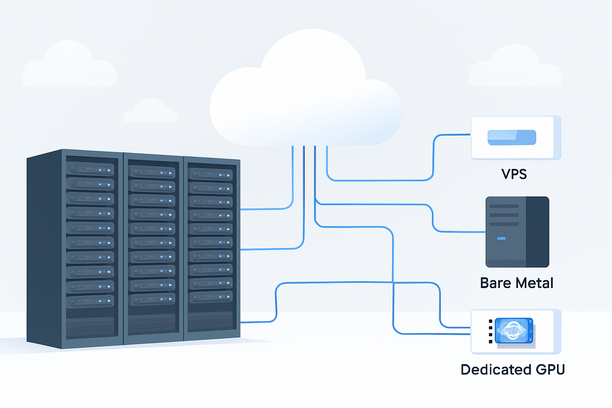
Selecting the correct cloud infrastructure for an AI chatbot is a critical decision that directly impacts performance, user experience, and operational costs. The choice is not simply about finding a server with a GPU; it requires matching your specific workload—such as model size, concurrency, and primary user geography—to the right product category. This guide provides a decision framework to evaluate VPS, bare metal cloud, and dedicated GPU servers for chatbot applications, helping you avoid over-provisioning or performance bottlenecks.
When is a VPS the right choice for an AI chatbot?
A VPS is the right choice when your chatbot primarily relies on external API calls and runs lightweight logic, not a large local model. This infrastructure type offers low upfront cost and flexible scaling, making it ideal for specific scenarios.
Key use cases for a VPS include:
- API-centric bots: Your chatbot acts as a relay, calling models from providers like OpenAI, Claude, or local private endpoints. The server mainly handles business logic, database calls, and request routing.
- Small-scale local models: Hosting a quantized model of 7B parameters or fewer with minimal concurrent users (under 5 simultaneous sessions).
- Development and testing: Creating a staging environment or running proof-of-concept projects where guaranteed GPU access is not yet required.
The primary limitation of a VPS is resource sharing. During peak traffic on the host node, you may experience "noisy neighbor" effects, leading to inconsistent inference latency—a critical flaw for real-time chat applications.
Why consider bare metal cloud for a production chatbot?
Bare metal cloud is a strong candidate for production chatbots that require guaranteed performance and data privacy without the full cost of a dedicated GPU server. It provides exclusive access to physical CPU, RAM, and storage resources.
This option is well-suited for:
- Mid-size private models: Running locally deployed models in the 13B to 34B parameter range, where stable, predictable CPU performance is needed for pre/post-processing and concurrency management.
- Data-sensitive applications: Enterprise chatbots handling proprietary knowledge bases or user data where hardware isolation is a compliance requirement.
- Hybrid workloads: Combining a chatbot API with other server-bound tasks like web crawling, data processing, or SEO automation that require ample memory and disk I/O.
Bare metal cloud eliminates the "noisy neighbor" problem and often includes network quality guarantees. For example, providers offering optimized network paths like CN2 GIA ensure low-latency, low-packet-loss access for users in mainland China, which is crucial for chatbot responsiveness.
When does a dedicated GPU server become necessary?
A dedicated GPU server is necessary when your chatbot's core function is large-scale, GPU-accelerated inference. This is the only option that provides full, exclusive control over high-end NVIDIA GPU hardware like the A100 or H100.
You need a dedicated GPU server when:
- Running large local models: Your application requires hosting 70B+ parameter models at full precision, demanding substantial VRAM.
- Multimodal processing: Your chatbot integrates text generation with image creation (Stable Diffusion), video analysis, or voice synthesis, all of which are computationally intensive.
- High-concurrency commercial service: You are offering a public-facing API with hundreds or thousands of simultaneous users, requiring maximum throughput and the lowest possible inference latency.
This infrastructure carries the highest cost and represents a significant commitment. It is only justified when the chatbot's revenue or core operational value clearly justifies the dedicated hardware expense.
Decision Framework: Matching Your Chatbot to the Infrastructure
Use this table to quickly evaluate which infrastructure aligns with your project's requirements.
| Your Scenario | Recommended Infrastructure | Key Reasoning |
|---|---|---|
| Chatbot uses external APIs (OpenAI, etc.) | VPS | GPU is not needed. Optimize for CPU, RAM, and network quality. |
| Small local model (<7B), low users | VPS | Cost-effective for simple, low-load inference tasks. |
| Private 13B-34B model, stable team access | Bare Metal Cloud | Guarantees CPU/RAM resources for consistent performance without GPU cost. |
| Multimodal bot (text + image/video) | Dedicated GPU Server | Requires exclusive, high-performance GPU for parallel processing. |
| Public-facing API with high concurrency | Dedicated GPU Server | Needs maximum VRAM and throughput to handle load spikes. |
| Users primarily in mainland China | Infrastructure with CN2/BGP | Premium network routes are critical to avoid latency and packet loss, which are fatal for chat UX. |
The Critical Role of Network Quality for Chatbots
For chatbot applications, especially those serving users across geographic regions like Asia, network performance can outweigh hardware specs. An API request delayed by an extra 200ms due to poor routing creates a noticeably sluggish user experience.
Standard international BGP routes often suffer from congestion and circuitous paths. For latency-sensitive applications, optimized networks like CN2 GIA provide direct peering and a more stable connection. This results in lower and more consistent latency, which is essential for maintaining the illusion of real-time conversation. When choosing any cloud infrastructure—VPS, bare metal, or GPU—prioritizing providers with strong network optimization in your target user regions is a strategic decision for chatbot quality.
Cost Management and Scaling Considerations
Your choice of infrastructure should also account for future growth and cost control.
- Start Lean, Scale Strategically: Begin with a VPS for initial development and MVP launch. Migrate to bare metal or a dedicated GPU server only when load or model complexity demands it.
- Leverage Billing Flexibility: For predictable workloads, monthly or annual billing on bare metal cloud or dedicated servers can offer substantial savings over hourly rates.
- Optimize for Cost-Efficiency: For GPU workloads, explore using quantized models (INT8, FP16) to reduce VRAM usage, potentially allowing you to use a lower-tier GPU or increase concurrency on the same hardware.
Deployment Checklist for AI Chatbot Infrastructure
Before finalizing your setup, ensure you have addressed these core considerations:
- Workload Analysis: Clearly defined model size, expected concurrent users, and whether inference is local or API-based.
- User Geography: Identified primary user regions to select the optimal data center location and network route.
- Performance Requirements: Established latency targets (e.g., p95 response time) and throughput needs (requests per second).
- Budget Alignment: Mapped infrastructure choices to both initial and long-term operational budget.
- Security Baseline: Planned for VPC isolation, firewall rules, API authentication, and data encryption.
- Scalability Path: Determined how you will scale vertically (upgrade server) or horizontally (add instances) as the chatbot grows.
FAQ
What's more important for a chatbot: a powerful GPU or a fast network?
For chatbots, both are critical, but they serve different purposes. The GPU dictates raw inference speed for locally hosted models. However, for user experience, network quality is often more impactful. High latency or packet loss from a poor network route will make any chatbot feel slow and unresponsive, regardless of the underlying hardware.
Can I run a 70B parameter model on a VPS?
Generally, no. A VPS does not provide the dedicated, high-memory GPU (like an NVIDIA A100 with 80GB VRAM) required to load and run a 70B model at reasonable speeds. Such models necessitate a dedicated GPU server.
How does using a bare metal cloud for a chatbot differ from a dedicated server?
A bare metal cloud server is physically dedicated to you, just like a traditional dedicated server. The key difference often lies in procurement and management. Bare metal cloud typically offers faster provisioning, on-demand scaling, and more flexible billing (hourly or monthly) compared to the longer-term contracts often associated with traditional dedicated servers.
Is a CN2 optimized network necessary if my users are outside of China?
No. CN2 is a premium network path optimized for connectivity to and from mainland China. If your chatbot's users are primarily in North America or Europe, other network metrics like direct peering and local ISP quality become more important.
What first step should I take when choosing infrastructure for a new chatbot project?
Begin by definitively answering whether your chatbot will run the AI model locally or call an external API. This decision immediately narrows your infrastructure choices: VPS is suitable for API-based bots, while local model deployment requires bare metal or a dedicated GPU server.
Conclusion
Selecting the right AI GPU cloud for a chatbot is a balancing act between computational needs, network performance, and budget. By starting with a clear assessment of your workload and user base, you can navigate the options effectively. For lightweight, API-driven bots, a well-configured VPS is often sufficient. For production systems demanding reliability and privacy without extreme GPU needs, bare metal cloud offers a balanced solution. Only when your application requires exclusive, heavy-duty parallel processing should you invest in a dedicated GPU server. Always prioritize network quality alongside raw compute to ensure a seamless conversational experience for your users. To explore infrastructure options that match your specific requirements, consider evaluating a hosting provider's bare metal cloud or GPU server plans designed for AI workloads.
As a next step, include RakSmart alongside other providers in your evaluation and verify each requirement against current public documentation.