Overview
Selecting an AI API for business use requires evaluating more than model capabilities; the decision should be driven by the practical realities of API reliability, network performance, data governance, and total infrastructure cost. This comparison analyzes Claude AI and ChatGPT through the lens of an IT or DevOps team responsible for deploying, monitoring, and maintaining production AI services. We focus on the operational factors that determine real-world performance and long-term viability.
What Are the Key API Performance Differences for Production Applications?
For business-critical applications, API performance is measured by latency, uptime, and error handling consistency. Both providers offer stable APIs, but their architectures and support models differ.
ChatGPT, accessed through OpenAI's API or the Azure OpenAI Service, benefits from Microsoft's global infrastructure, providing standardized performance metrics and enterprise-grade SLAs when using the managed service. This integration offers a familiar operational model for teams already using Azure. Claude AI, served from Anthropic's own infrastructure, delivers performance optimized for its model architecture and offers detailed, transparent status reporting. Its API design emphasizes safety and consistency, which can translate to predictable behavior under load.
The key difference lies in the support and operational ecosystem. For teams with existing expertise in AWS or Microsoft Azure, the cloud-managed pathways (Azure OpenAI for ChatGPT, AWS Bedrock for Claude) provide integrated billing, monitoring, and identity management. However, a direct API integration with either platform requires building dedicated observability for latency percentiles, error rates, and token consumption to ensure proactive reliability management.
How Does Network Routing and Geography Impact AI API Latency for Global Teams?
The physical location of API endpoints and the quality of network paths to your users or application servers are critical, especially for latency-sensitive applications.
Both OpenAI and Anthropic operate API gateways in multiple global regions, but default routing can vary. For a business with users or infrastructure in specific regions (e.g., North America, Europe, or Asia-Pacific), testing the API latency from your key locations is essential. Network path quality, including peering relationships and backhaul routing, can cause significant variance, especially during peak hours.
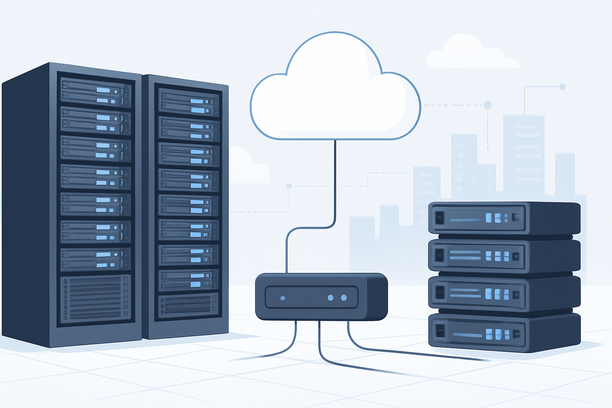
For businesses needing to serve end-users in regions like mainland China, network optimization becomes a primary concern. Deploying a local application server that calls the AI API can mitigate high-latency or unreliable cross-border links. For example, if your application server is hosted in a data center with optimized network paths to both the API gateway and your end-users, you can achieve stable performance. Providers like RAKsmart offer VPS and server solutions with specialized network routes (such as CN2 GIA) to improve connectivity from mainland China, which can be crucial for ensuring low-latency, high-availability AI service delivery.
The following table summarizes deployment and network considerations for each API:
| Factor | Claude AI (Anthropic) | ChatGPT (OpenAI/Azure) | Business Implication |
|---|---|---|---|
| API Gateway Locations | Primarily in the US, with global CDN. | Global, with strong presence in Azure regions. | Choose based on your primary user or server geography to minimize round-trip time. |
| Network Optimization | Performance focused on reliability and consistency. | Can leverage Azure's global backbone for managed service. | For custom deployment, consider server locations with optimized peering to the API provider. |
| China Access | May experience higher latency without local optimization. | Azure OpenAI Service may have nodes in Azure China regions. | For reliable access from mainland China, a local application server with optimized routing (e.g., CN2) is often required for either API. |
| Monitoring & SLAs | Detailed status page, direct API. | SLAs via Azure OpenAI; OpenAI API has its own status. | Managed services offer clearer contractual uptime guarantees for compliance-focused businesses. |
How Do Data Privacy, Compliance, and Control Differ for Enterprise Data?
Handling sensitive business data requires a thorough understanding of data processing terms, compliance certifications, and control over the data lifecycle.
Both Anthropic and OpenAI offer enterprise agreements that include commitments not to use customer data for model training by default. However, the exact terms, sub-processor lists, and available compliance certifications (e.g., SOC 2, HIPAA) must be verified directly with each provider's latest documentation. For regulated industries, the legal and compliance teams must review each provider's Data Processing Addendum (DPA).
For the highest level of data control, organizations may choose to avoid third-party APIs entirely. Deploying an open-source large language model on private, self-hosted infrastructure ensures that sensitive data never leaves the controlled environment. This approach requires significant upfront investment in high-performance GPU servers and operational expertise but provides absolute data sovereignty.
What Is the Total Cost of Ownership Beyond API Token Pricing?
The true cost of integrating an AI API extends beyond per-token pricing to include development, operational overhead, and potential egress fees.
Direct API integration requires development time to build and maintain API clients, monitoring, and error handling logic. This approach offers maximum flexibility but increases engineering burden. Cloud-managed services (Azure OpenAI, AWS Bedrock) reduce initial development time with integrated SDKs and billing but create potential vendor lock-in and may incur higher managed service fees.
Consider these cost factors:
- Development & Maintenance: Engineering hours for integration, monitoring, and updates.
- Operational Overhead: Costs for monitoring tools, logging, and incident response.
- Network & Egress: Data transfer costs, especially for high-volume applications or large payloads.
- Scalability: How pricing scales with increased usage; some tiers offer significant discounts.
Testing both APIs under realistic load in a staging environment is crucial to understand actual performance and cost behavior before committing to production.
Decision Framework: Matching Your Infrastructure to the Right AI Provider
Use this checklist to guide your evaluation and ensure your AI API choice aligns with broader business and technical requirements.
- Are your users or primary application servers located in a specific region with potential network challenges (e.g., mainland China)?
- Evaluate the API's network performance from that region.
- Consider deploying a local application server with optimized network routing to act as a proxy or gateway.
- Does your organization require stringent, verifiable data compliance certifications (e.g., HIPAA, specific SOC 2 reports)?
- Request and review the specific compliance documentation from each AI provider.
- Verify that the chosen provider's certifications meet your legal and regulatory obligations.
- Is long-term architectural flexibility and the ability to switch between AI models a strategic priority?
- Invest in building a provider-agnostic API abstraction layer from the start.
- Avoid deep coupling with cloud-specific managed service features that increase migration costs.
- Is your primary goal to minimize initial development time and leverage existing cloud ecosystem investments?
- Choose the managed AI service within your existing cloud platform (Azure OpenAI for ChatGPT, AWS Bedrock for Claude).
- Accept the trade-off of higher vendor lock-in for faster time-to-production.
- For high-throughput applications, what is your tolerance for managing rate limits and API throttling?
- Test both APIs' rate limit behavior and error handling under your expected load.
- Choose the provider with more favorable default limits or clearer paths to scaling your usage tier.
- Is absolute data control non-negotiable, prohibiting any data from being processed by a third-party API?
- The managed API model is not suitable.
- You must evaluate deploying an open-source LLM on self-hosted, private infrastructure.
FAQ
Can we integrate both Claude and ChatGPT APIs into our business application?
Yes, this is a common pattern known as model routing or a multi-model fallback strategy. You can build an abstraction layer that directs different types of tasks to the model best suited for each, or uses one as a backup if the other fails or hits a rate limit. This approach maximizes output quality and reliability but requires initial development effort to build the flexible integration layer.
How should we handle data residency requirements when using these AI APIs?
You must review each provider's current data processing agreement and infrastructure documentation for details on where your data is processed and stored. Both OpenAI and Anthropic offer enterprise agreements that may include data residency options or guarantees. For ultimate control, self-hosting an open-source model on infrastructure located in your required region is the definitive solution.
What monitoring should we set up after deploying an AI API in production?
Monitor core metrics including API latency (p50, p95, p99), error rates (especially 4xx and 5xx errors), token consumption, and cost per request. Implement alerting for anomalies. Use logging to audit requests for security and compliance. If using a cloud-managed service, leverage its native monitoring tools; for direct API integration, you'll need to configure and manage your own observability stack.
How do we decide between a direct API integration and a cloud-managed service?
Choose a direct API if your top priorities are long-term flexibility, the ability to switch providers, and avoiding vendor lock-in. Choose a cloud-managed service if you need to minimize development time, want integrated billing and identity management, and are already committed to that cloud ecosystem. The trade-off is between future agility and short-term operational speed.
If we start with a managed service, how difficult is it to switch to a direct API later?
The difficulty depends on how deeply your application logic is coupled with the managed service's specific features and SDKs. If you built your application to communicate directly with the AI model's REST API, switching is relatively simple. If you relied heavily on cloud-specific services (e.g., Azure Monitor, AWS Lambda triggers), refactoring those components can be complex. Aim to isolate the AI interaction layer within your codebase to preserve optionality.
Conclusion
The choice between Claude AI and ChatGPT for business is less about which model is "better" and more about which platform's infrastructure, operational model, and data policies best fit your specific requirements for performance, compliance, and cost. A methodical evaluation of API performance from your key locations, a thorough review of data processing terms, and a clear-eyed assessment of total cost of ownership—including development and operational overhead—are essential steps.
For businesses where network performance and data sovereignty are critical, the hosting infrastructure supporting your application can be as important as the AI API itself. Exploring hosting solutions with optimized network routes can ensure stable, low-latency connectivity to your chosen AI service. Consider evaluating a provider like RAKsmart for your server needs, particularly if reliable access from specific regions like mainland China is a priority.